Family Guide · Paris
Paris with Kids: Where to Stay (and How to Actually Enjoy the City as a Family)
A local's honest guide to family-friendly neighbourhoods, apartments over hotels, and the small logistics that make or break the trip.
Paris with children is not the Paris of honeymooners and long café lunches — and that is entirely the point. Done well, it is croissants on a quiet balcony, a scooter ride down a plane-tree avenue, a carousel at dusk, and everyone in bed by nine. Done badly, it is a cramped hotel room, a stroller stuck in a métro turnstile, and a four-year-old melting down at the Louvre. This guide is about doing it well.
See our Paris apartments → Book direct — up to 5% less than Airbnb & BookingWhy an apartment beats a hotel in Paris with kids
A standard Paris hotel room is small. A Paris hotel room designed for four people is often two small rooms bolted together, or a single room with a pull-out sofa that eats the floor space you needed for a suitcase. With one child you can make it work; with two, or with a baby who naps, hotels start to feel like a compromise you paid a premium for.
An apartment changes the maths. You get a real bedroom with a door that closes, a living room where the adults can eat dinner and pour a glass of wine after bedtime, and — the quiet game-changer — a kitchen. Not to cook elaborate meals, but to handle breakfast on your own timetable, warm a bottle at three in the morning, keep grapes and yoghurt in the fridge, and reheat last night's roast chicken from the traiteur when nobody has the energy for another restaurant.
There is also the laundry question, which sounds boring until day four when someone has spilled hot chocolate on the only clean jumper. A washing machine is not glamour; it is sanity. And most family-sized Paris apartments have one.
Rule of thumb: if the trip is longer than three nights, or if a child is under six, an apartment will out-perform any hotel in the same price bracket.
The best Paris neighbourhoods for families
Parisians raise children in Paris, and they do it in specific quartiers for specific reasons: green space, good bakeries, quiet streets in the evening, a métro line that goes where you need to go, and enough residential fabric that a five-year-old on a scooter is not weaving through nightlife crowds at seven pm.
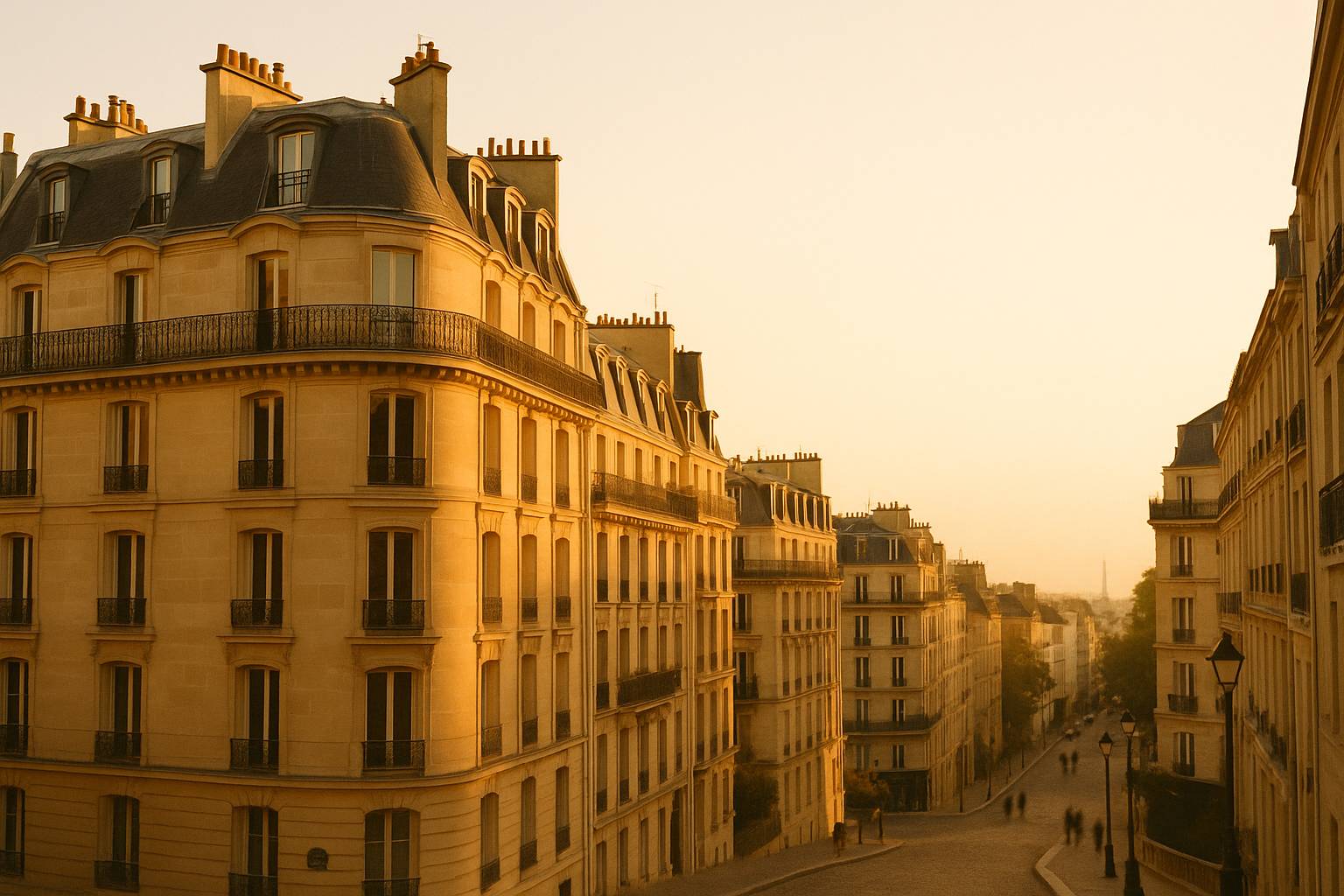
The neighbourhoods that consistently work for visiting families are the 7th, the 15th, the western half of the 6th, the 16th around Passy and Trocadéro, and the quieter parts of the 5th near the Jardin des Plantes. These are not the most Instagrammed corners of the city, and that is precisely why they work. You are staying where Parisian families live, which means playgrounds, pharmacies, greengrocers and paediatricians are all within a short walk.
- 7th arrondissement: the Eiffel Tower, the Champ de Mars, Rue Cler — postcard Paris with real residential calm.
- 15th arrondissement: local, affordable, superb food streets, easy river access.
- 6th (west): the Luxembourg Gardens on your doorstep, the best playground in central Paris.
- 16th (Passy/Trocadéro): leafy, bourgeois, quiet at night, brilliant for very young children.
- 5th (Jardin des Plantes side): museums geared to kids, a natural history museum with a zoo attached.
The 7th: classic Paris, calm streets, Eiffel Tower on tap
If it is your first family trip to Paris, stay in the 7th and don't overthink it. The arrondissement wraps around the Champ de Mars, which is essentially a giant lawn beneath the Eiffel Tower where children can run flat-out for an hour while adults sit on a bench with a coffee. That single fact justifies the whole quartier.
The 7th is also where you find Rue Cler, a pedestrianised market street lined with cheesemongers, fruit stalls, a proper boulangerie and cafés with pavement tables. It is the easiest place in Paris to assemble a family picnic without a plan. Around it, the residential streets are wide, low-traffic and lined with Haussmann apartment buildings — meaning almost every rental has real ceiling height, real windows and, often, a balcony.
The trade-off is price and a slight sense of theme-park Paris around the tower itself. Stay two or three streets back — near Rue Saint-Dominique or Avenue de Ségur — and you get the postcard without the crowds.
The 15th: where Parisian families actually live
The 15th is the largest arrondissement by population and is, quietly, one of the best places to stay in Paris with kids. It has no headline monuments, which keeps prices sensible and tourist density low, but it borders the Seine, wraps around the Champ de Mars from the south, and is threaded by métro lines 6, 8, 10 and 12 — meaning you can be at the Louvre, the Marais or Montmartre in twenty minutes.
The food streets are exceptional: Rue du Commerce and Rue de la Convention are lined with independent boulangeries, cheesemongers and the kind of neighbourhood bistros where a high chair appears without you asking. Parc André Citroën, on the river, has a tethered helium balloon that lifts children 150 metres above the city — a genuinely thrilling twenty minutes and far cheaper than the Eiffel Tower lift.
Choose the 15th if you want a longer stay, if you have three or more children, or if you want your Paris to feel less like a set and more like a life you might briefly borrow.
Other quartiers worth considering
The 6th, near the Luxembourg Gardens
The Jardin du Luxembourg is the best public playground in central Paris — literally. There is a paid enclosed play area with slides, climbing frames and sand, a pond for toy sailboats you rent by the half-hour, pony rides, a marionette theatre that has been running since 1933, and enough gravel paths to exhaust a determined seven-year-old. Staying within a five-minute walk of the north or west gates changes the shape of your whole trip.
The 16th, around Passy and Trocadéro
Quiet, green, slightly formal, and blessed with the Jardins du Trocadéro directly across the Seine from the Eiffel Tower. Very good for families with children under five, who need naps and don't yet care about nightlife. The Musée en Herbe and the Cité de l'Architecture are both in the neighbourhood, and the Bois de Boulogne — with the Jardin d'Acclimatation, an old-fashioned children's amusement park — is a short métro ride away.
The 5th, near the Jardin des Plantes
Underrated for families. The Jardin des Plantes contains a small zoo (the Ménagerie), the Grande Galerie de l'Évolution with its extraordinary parade of taxidermied animals, and enough space for kids to run. The surrounding streets, particularly around Rue Mouffetard, are lively without being rowdy.
Areas we'd skip with young children
None of Paris is unsafe in any meaningful sense, but some quartiers are simply not designed around family logistics. The heart of the Marais (3rd and 4th) is beautiful and we love it, but the streets are narrow, crowded, and full of one-hour queues for pastries. Strollers are a constant negotiation, and evening dinners are late and loud.
Pigalle and South Pigalle ("SoPi") have become fashionable, but the neighbourhood still tips into nightlife after dark, and the walk home from dinner is not what you want with a sleeping four-year-old on your shoulder. The area immediately around Gare du Nord and Gare de l'Est can feel rough and is worth avoiding as a base, though the stations themselves are perfectly fine to pass through. Montmartre proper is charming but hilly, cobbled, and hostile to strollers; visit for a morning, don't sleep there.
What to actually do with kids in Paris
The mistake most families make is trying to do adult Paris with children attached. It does not work. Louvre queues, three-course lunches and long walks through the Marais will break a small person by day two. The better approach is to plan one "anchor" activity per day, ideally in the morning, and leave the afternoon loose for a park, a playground or a nap.
Museums that genuinely work with children: the Musée d'Orsay (big, bright, one hour is enough), the Grande Galerie de l'Évolution, the Cité des Sciences at La Villette (an entire science museum built for kids, with a dedicated under-6 zone), the Musée de la Marine at Trocadéro, and the Louvre only if you have a specific plan — go straight to the Egyptian antiquities, do forty minutes, leave. The Aquarium de Paris at Trocadéro is small but well done, with a cinema showing short films that give everyone twenty minutes off their feet.
Outdoors, the essentials are the Luxembourg Gardens, the Tuileries (with a small funfair from late June through August), the Champ de Mars, the Jardin d'Acclimatation in the Bois de Boulogne, and a Bateaux Mouches river cruise at dusk — one hour, seated, spectacular, and universally loved by children between three and ten.
- Take the lift up the Eiffel Tower at sunset, book online weeks ahead, second floor is enough.
- Do the Seine by boat once, at dusk — it resets the whole trip.
- Pick one big park per day and let the kids lead.
- Ice cream at Berthillon on Île Saint-Louis is worth the walk, once.
Logistics: métro, strollers, meals, timings
The Paris métro is fast, cheap and, for stroller-pushing parents, a daily irritation. Many stations have no lift, staircases are steep, and turnstiles are narrow. Buses are the underrated solution: routes 42, 63, 69, 72, 82 and 87 cover most of the tourist geography, run above ground (which children infinitely prefer), and accept strollers without drama. Get a Navigo Easy card at any station, load it with a carnet of ten tickets, and use it interchangeably on métro, bus and tram.
Meals are the other axis to plan around. French restaurants generally open for dinner at 7 or 7:30 pm, which is late for young children. The workaround is either an early bistro (brasseries serve continuously — Le Petit Cler in the 7th, Le Suffren near the Champ de Mars, most brasseries near stations), a picnic assembled from a market street, or dinner at the apartment. This is where the kitchen earns its keep: a rotisserie chicken from the traiteur, a baguette, some ratatouille from the fromagerie, and everyone eats at 6:30 in pyjamas.
Pharmacies (the green cross) are everywhere and staff usually speak enough English to help with a fever, a rash or a scraped knee. Public toilets are scarce; use café toilets and buy a coffee, or use the free automatic sanisettes on the street, which are cleaner than their reputation.
A sample four-day family itinerary
Day one — arrival and the Eiffel Tower quartier. Land, drop bags, walk to the Champ de Mars, let the children run. Early dinner on Rue Cler. Bed by nine. Do not attempt a museum on arrival day; you will regret it.
Day two — Luxembourg Gardens and the Left Bank. Morning at the Luxembourg (playground, sailboats, marionettes), lunch at a bistro nearby, afternoon at the Musée d'Orsay for one focused hour (the Impressionist floor only). Bateaux Mouches cruise at sunset from the Pont de l'Alma.
Day three — La Villette and the north-east. Cité des Sciences in the morning (allow three hours), picnic in the Parc de la Villette. Optional afternoon at Canal Saint-Martin, but only if the children still have legs. Otherwise, back to the apartment for downtime.
Day four — Trocadéro, Passy, departure. Aquarium de Paris or the Musée de la Marine in the morning, lunch at Trocadéro with the tower view, gentle walk down through the Jardins du Trocadéro, ice cream, home. Fly out.
Notice what is missing: Montmartre, the Marais, the Louvre proper, Versailles. All are wonderful. None of them belong in a first family trip. Save them for when the youngest is seven.
Tours & experiences to book
A handful of well-chosen experiences make the difference between a trip children remember and a trip that blurs. Skip-the-line tickets are non-negotiable at the Eiffel Tower and the Louvre; a family-friendly guide is worth every euro at the bigger museums. Below, a curated selection we would book ourselves.
Paris City Center Free Walking Tour (Tip-Based)
Paris in A Day Louvre Eiffel Tower Notre Dame and Seine Cruise
Paris by Night
French Wine and Champagne Tasting in Paris
Transfers between Paris and Paris Airports/Disneyland/Versailles
Paris French Bakery Experience Le Marais
Experiences offered via Viator — booking may earn Lavie Maison a commission, at no extra cost to you.
Stay in the neighbourhood: our Paris apartments
Book direct with us — the same homes, up to 5% less than on Airbnb or Booking.
Lavie Maison : Terrace & AC
Auteuil
Lavie Maison Sauna Hot Tub & AC
Invalides – Gros-Caillou
Lavie Maison Chic Sauna Hot Tub
Le Marais
See all our Paris apartments →
Compare with real hotel prices in Paris →
Where to stay with Lavie Maison in Paris
Our Paris apartments sit in exactly the quartiers this guide recommends — the 7th, the 15th, the quieter edges of the 6th and 16th — because those are the neighbourhoods where families actually live, and where a short stay feels less like tourism and more like a temporary Parisian life. Each apartment has a proper kitchen, a washing machine, real bedrooms with doors that close, and enough living space that the adults get an evening back once children are in bed.
We are a small, independent brand. When you book direct on lavie.maison rather than through a large OTA, the price is up to 5% lower — because we are not paying a platform commission, and we pass that saving to you rather than pocket it. You also deal with us directly for the arrival, the code, the extra travel cot, the highchair, the recommendation on where to buy nappies at nine pm on a Sunday. That is not a call centre in another country; it is a small team in Paris.
Browse our Paris apartments to see which quartier suits your family. Two-bedroom flats near the Champ de Mars for the classic first trip; larger apartments in the 15th for longer stays and bigger families; quieter options in the 16th for very young children. If you are not sure, write to us and describe the ages of your children — we will point you to the right flat.
Frequently asked questions
What is the best area to stay in Paris with kids?
The 7th arrondissement is the easiest first choice — calm residential streets, the Champ de Mars for running, Rue Cler for food, and the Eiffel Tower a short walk away. For longer stays or bigger families, the 15th offers similar calm at better value, and the 6th near the Luxembourg Gardens is unbeatable if your children are between three and eight.
Is it better to stay in a hotel or an apartment in Paris with children?
For any trip longer than three nights, or with children under six, an apartment almost always wins. You get a real bedroom, a kitchen for breakfasts and bottles, a washing machine, and living space where adults can eat once kids are asleep. Family-sized Paris hotel rooms are small and expensive.
Which arrondissements should families avoid in Paris?
Nowhere in central Paris is unsafe, but Pigalle and South Pigalle tip into nightlife after dark, the immediate area around Gare du Nord can feel rough, and Montmartre's cobbles and hills are hostile to strollers. The heart of the Marais is charming but crowded and better visited than slept in with young kids.
How many days do you need in Paris with kids?
Four full days is the sweet spot — enough for the Eiffel Tower, one or two museums, the Luxembourg Gardens, a river cruise and a science museum, without over-scheduling. Three days works if you focus tightly on one quartier; a week lets you add day trips like Versailles or Giverny once the youngest is old enough.
Is the Paris métro practical with a stroller?
Honestly, not really. Many stations lack lifts and staircases are steep. Use city buses instead — routes 42, 63, 69, 72, 82 and 87 cover most tourist areas, run above ground, and take strollers without fuss. A Navigo Easy card works on both, so you can mix and match.
What should we book in advance for a family trip to Paris?
Book the Eiffel Tower lift online several weeks ahead (aim for sunset, second floor is enough), a Seine river cruise for one evening, and skip-the-line tickets for any museum you're serious about visiting. Restaurants generally don't need reservations for lunch, but book dinner if you want a specific bistro on a Friday or Saturday.