
Paris
Paris
Real availability, best price guaranteed
Pick your dates to see live prices
Where to stay in July · air-con & outdoor space


Épinettes – Guy Môquet
52 beds · 1 bath · 6 guests
From €104 / night


Auteuil
51 bed · 1 bath · 3 guests
From €148 / night


Auteuil
52 beds · 1 bath · 6 guests
From €200 / night


Épinettes – Guy Môquet
1 bed · 1 bath · 4 guests
From €75 / night


Invalides – Gros-Caillou
51 bed · 1 bath · 2 guests
From €106 / night


Auteuil
51 bed · 1 bath · 2 guests
From €94 / night
July in Paris is hot and long. Daytime temperatures typically hover between 24 and 26 °C, but the city now sees genuine heatwaves — a canicule can push the mercury to 32–36 °C for several days running, and the stone holds heat long after midnight. The trade-off is the light: the sun doesn't set until around 10 pm, stretching evenings into pavement dinners and riverside strolls.
Two practical factors shape a July stay. First, most of the older Haussmann-era buildings have no air conditioning — during a hot week, an apartment that does makes the difference between sleeping and not sleeping. Second, it's peak tourist season, but Parisians don't leave for their grandes vacances until late July: early and mid-month, the city is fully alive — markets, terrasses and bistros, everything is open.
Getting around is easy, and in summer often more pleasant above ground: the city is walkable, the Vélib' is a joy along the Seine, and the métro — hot on the platforms, granted — will get you anywhere in twenty minutes. One July-specific thing to watch: certain métro lines undergo summer engineering works, so check yours before counting on it late in the evening.
If you can choose your week, the first three weeks of July are the sweet spot: the weather is reliably warm, every event is in full swing, and the city hasn't yet emptied for August. Pack light, breathable clothes, genuinely comfortable shoes for the cobblestones, add a thin layer for over-air-conditioned trains and museums, and don't forget sunglasses and a reusable water bottle — you'll reach for them every day.
Tip
Book timed tickets for the tour Eiffel, the Louvre and Versailles several days ahead. In July they sell out consistently, and queuing in 30 °C heat is nobody's idea of a holiday.
The Fête Nationale is the centrepiece of the month, and Paris marks it accordingly. The morning belongs to the military parade on the Champs-Élysées, which steps off at 10 am — the oldest and largest regular parade in Europe, with an aerial flyover of the avenue.
Public viewing areas stretch along the lower Champs-Élysées towards the place de la Concorde. Crowds are thick by 9 am and bag checks slow entry: come early, travel light, and pick a spot with a clear sightline to the avenue for the opening flyover. If standing for hours in the sun isn't your thing, many cafés along the route open early — a seat by the window beats the crush.
The night belongs to the fireworks. They're launched around 11 pm from the tour Eiffel and last roughly 35 minutes, set to music. The classic vantage points are the lawn of the Champ-de-Mars directly below and, across the river, the terraces of the Trocadéro — both fill hours in advance, and several nearby métro stations close or go one-way to manage the crowd.
If you'd rather not be pressed shoulder to shoulder, skip the Champ-de-Mars scrum. The bridges upstream — around the pont de Bir-Hakeim or the pont Alexandre III — give you the tower in profile with room to breathe, and the Seine carries the sound. Bring a picnic, claim a stretch of pavement by 9 pm and eat early: restaurants near the river are overwhelmed and many close before the show.
Good to know
On the evening of the 13th — and sometimes the 14th — fire stations across the city host the Bals des Pompiers: open doors, music and dancing late into the night, for a small entrance contribution. A beloved and slightly chaotic Parisian tradition, far less touristy than the parade.
Every summer, Paris trucks in sand and deckchairs and turns stretches of riverbank into free urban beaches. In 2026, Paris Plages runs from 6 July to 1 September across several sites — the main ones being the Rives de Seine in the centre and the Bassin de la Villette in the north-east, where the canal also offers kayaking, paddleboarding and outdoor dance and fitness classes.
The headline of the decade: you can swim in the Seine again. Supervised and free Seine swimming sites opened as a legacy of the 2024 Olympic Games — a genuinely new thing to do in July — but their opening depends on weather and water quality: check the day's status before packing your towel. Everything is free; go early or in the evening to avoid the midday crowds.
At the Bassin de la Villette, the atmosphere is part seaside, part neighbourhood fête — pedalos and paddleboards on the water, pétanque and ping-pong on the quayside, and queues at the ice-cream stands that speak of summer better than any guidebook. It's free, genuinely local, and one of the nicest ways to spend a hot afternoon without leaving the city.
After three weeks and the high mountains, the Tour de France finishes in Paris on Sunday 26 July 2026. The race has brought its grand arrival back to the capital, and this year's final stage sets off from Thoiry and covers around 130 km into Paris — keeping the addition the organisers introduced recently: riders climb the cobbled Côte de la Butte Montmartre, whose summit sits just 6.1 km from the finish line.
That makes Montmartre, and not only the Champs-Élysées, a prime free vantage point in 2026 — the climb in front of the Sacré-Cœur becomes a roaring wall of spectators. Wherever you stand, arrive hours in advance; the centre closes to traffic and the best kerbside spots go early. The spectacle is free.
The city's flagship summer festival takes over courtyards, gardens and unexpected venues with dance, theatre, circus and concerts for three weeks. A good part of the programme is free or low-cost, and it's the simplest way to stumble across a memorable moment on a summer evening.
For five days, the Arènes de Lutèce — Paris's still-standing Roman amphitheatre, tucked behind the Quartier latin — host a festival celebrating the Paris–Rome twinning, with open-air film screenings, exhibitions and Italian gastronomy. Sitting in a 2,000-year-old arena on a summer evening is reason enough to make the trip.
Weather to expect
Typical daytime high 25°C, overnight low 15°C. Averages from the last five years (2021–2025).
Top number: average daytime high · bottom: average overnight low.
Out at the bois de Vincennes, the Parc Floral puts on jazz and classical concerts at weekends throughout the summer; park entry is just €2.50 and you listen lying in the grass. After dark, the open-air cinema on the lawn of the Parc de la Villette screens films for free from mid-July — bring a blanket, a picnic, and settle in under the stars.
Two more summer fixtures worth knowing: the Fête des Tuileries, a traditional fairground that sets up in the Jardin des Tuileries from late June through August with a big wheel and old-fashioned rides, and the Nuit aux Invalides, a sound-and-light show projected after dark onto the courtyard of the Hôtel des Invalides throughout the summer. Two reliable, easy choices, perfect for a warm evening.
July is a strong month for major exhibitions, and the museums stay cool. At the musée d'Orsay, Renoir et l'amour brings together around fifty major Impressionist works and runs until 19 July 2026 — book a timed slot, as summer queues at Orsay are long. Across the city, several major museums offer one late-night opening per week: cooler, quieter, and far more pleasant than the midday crush.
Worth knowing: many national museums are free on the first Sunday of the month — a great opportunity, but crowds are heavy, and in July a paid weekday evening visit is generally the calmer choice. And on a sweltering afternoon, a museum remains simply the best air-conditioned refuge in the city — one that also happens to be beautiful.
July is the month to use Paris as a base. An hour to the west, Giverny puts you in Monet's garden with the lily pond and the green Japanese bridge at their flowering peak — come early on a weekday and you'll have the famous bridge almost to yourself before the coaches arrive.
Closer still, Versailles is at its summer best for the gardens rather than the gilded rooms. Every weekend throughout the season, the Grandes Eaux Musicales set the fountains dancing to Baroque music, and on summer Saturday evenings the Grandes Eaux Nocturnes transform the groves into an illuminated promenade ending with fireworks over the Grand Canal. Go for the garden spectacle, not just the château — and book ahead, as Saturday evenings fill quickly.
Beyond the big events, July is the month when Paris's ordinary rhythms are at their most seductive — and most of them cost next to nothing.
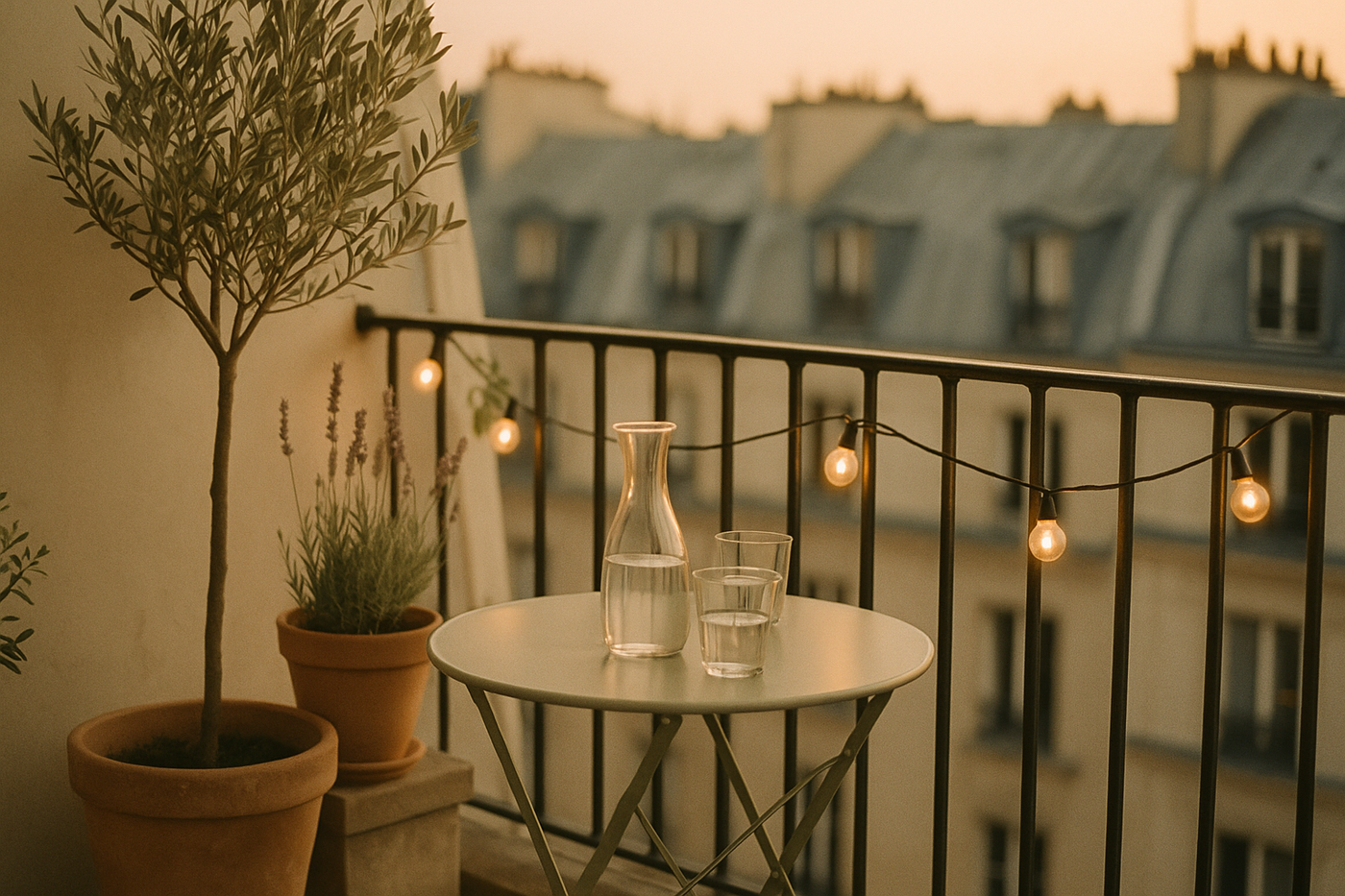
For July, we guide our guests towards apartments with air conditioning and a terrasse or balcon — a cool refuge when the heat bears down on the city, and a private outdoor corner for those long golden evenings. Below are a few of our summer-ready addresses; every Lavie Maison stay is self-check-in, with a real équipe in France a phone call away and rates kept below the major platforms.
Is July a good time to visit Paris?
Yes — it's lively, sunny and full of events, from 14 July to Paris Plages to the Tour de France finish. The trade-offs are crowds at the major sites and the occasional canicule, both of which are easy to plan around by booking tickets in advance and choosing an air-conditioned apartment.
How hot is Paris in July, and do you need air conditioning?
Highs typically sit between 24 and 26 °C, but heatwaves can push the mercury to 32–36 °C for several days running, and older buildings hold heat at night. If you're sensitive to heat or a light sleeper, an air-conditioned apartment is genuinely worth it in July.
Where to watch the 14 July fireworks?
They're launched from the tour Eiffel at around 11 pm on 14 July. The Champ-de-Mars and the Trocadéro are the classic spots but fill hours in advance; for more space, try the bridges upstream such as the pont de Bir-Hakeim or the pont Alexandre III, and arrive around 9 pm.
When are the summer sales in Paris in 2026?
The French summer sales run from 24 June to 21 July 2026 across most of the country, with the biggest reductions in the final week, in mid-July.
Can you really swim in the Seine now?
Yes — supervised and free Seine swimming sites opened as a legacy of the 2024 Olympic Games and operate in summer, subject to water quality and weather. Check the day's status before you set out, as sites can close after heavy rain.
Is everything closed in Paris in July?
No. The great August shutdown hasn't begun in early and mid-July: markets, shops and most restaurants are open. Closures pick up towards the very end of the month, so it's worth booking dinner a day or two ahead.
Fill your days
A few we'd send friends to in Paris this month — book early, the good ones sell out in season.


We may earn a small commission on these experiences, at no extra cost to you.
Ready when you are
Best price guaranteed when booked direct, no platform fees, self check-in 24/7.
Or call +33 7 45 89 66 69 — a real team in France answers within minutes.
We negotiated a discount on Airbnb Experiences just for our guests. Enter this code at checkout — good for up to 2 experiences per traveller, and anyone in your group with an Airbnb account can use it too.
EXP-LAVIEMAISONLe Marais
Quartier
Eiffel Tower
Quartier
Paris Louvre
Quartier
Pet friendly
Thème
With jacuzzi
Thème
Air conditioning
Thème
Saint-Germain (6e)
Quartier
Monthly stays
Thème
Family apartments
Thème
2-bedroom apartments
Thème
Large apartments (groups)
Thème
Near Paris Expo
Thème
City center
Thème
Vacation rentals
Thème
Short-term rentals
Thème
6 curated apartments, self check-in 24/7, real team in France, prices up to 5% lower than Airbnb.
See available dates