City Guide · Bordeaux
Where to Stay in Bordeaux for Wine Tasting (Without a Car)
The neighbourhoods, trains and small choices that turn a wine weekend into something quietly great.
Bordeaux is one of the few great wine capitals you can actually enjoy without a car. The vineyards begin twenty minutes from the station, the city itself pours generously, and where you sleep decides how easy — or how exhausting — the whole thing feels. This guide is about that decision.
See our Bordeaux apartments → Book direct — up to 5% less than Airbnb & BookingWhy base yourself in the city, not in the vineyards
The instinct, when you plan a wine trip, is to picture yourself waking up in a château surrounded by vines. It is a lovely image and, for most travellers, a logistical trap. The Bordeaux appellations are vast — Médoc alone stretches nearly eighty kilometres north of the city — and once you commit to sleeping among the vineyards you inherit a car, a designated driver, rural dinners, and the quiet stress of finding your way back down unlit D-roads after a generous pour of Pauillac.
Basing yourself in Bordeaux itself flips the equation. The city sits at the exact geographical hinge of the region, with direct trains east to Saint-Émilion, north to the Médoc, and south to Graves and Sauternes. You leave in the morning with a small bag, taste all day in one or two estates, and are back on a tram by six with time for a shower, an oyster bar on Rue du Pas-Saint-Georges, and a proper dinner. Your evenings stay urban; your days stay rural. It is, honestly, the best of both.
There is a second reason, less often mentioned. Bordeaux has quietly become one of the finest food-and-wine cities in France in its own right. Since the quays were pedestrianised and the tram network built out, the historic centre has filled with wine bars pouring by the glass from producers you would otherwise never meet — small Blaye, obscure Fronsac, natural Entre-deux-Mers. Sleeping in town means you keep tasting after the châteaux close.
The best neighbourhoods for wine lovers
Not every Bordeaux neighbourhood is equally useful when your itinerary revolves around trains and tastings. Four stand out, each with a different personality.
Triangle d'Or & Grand Théâtre
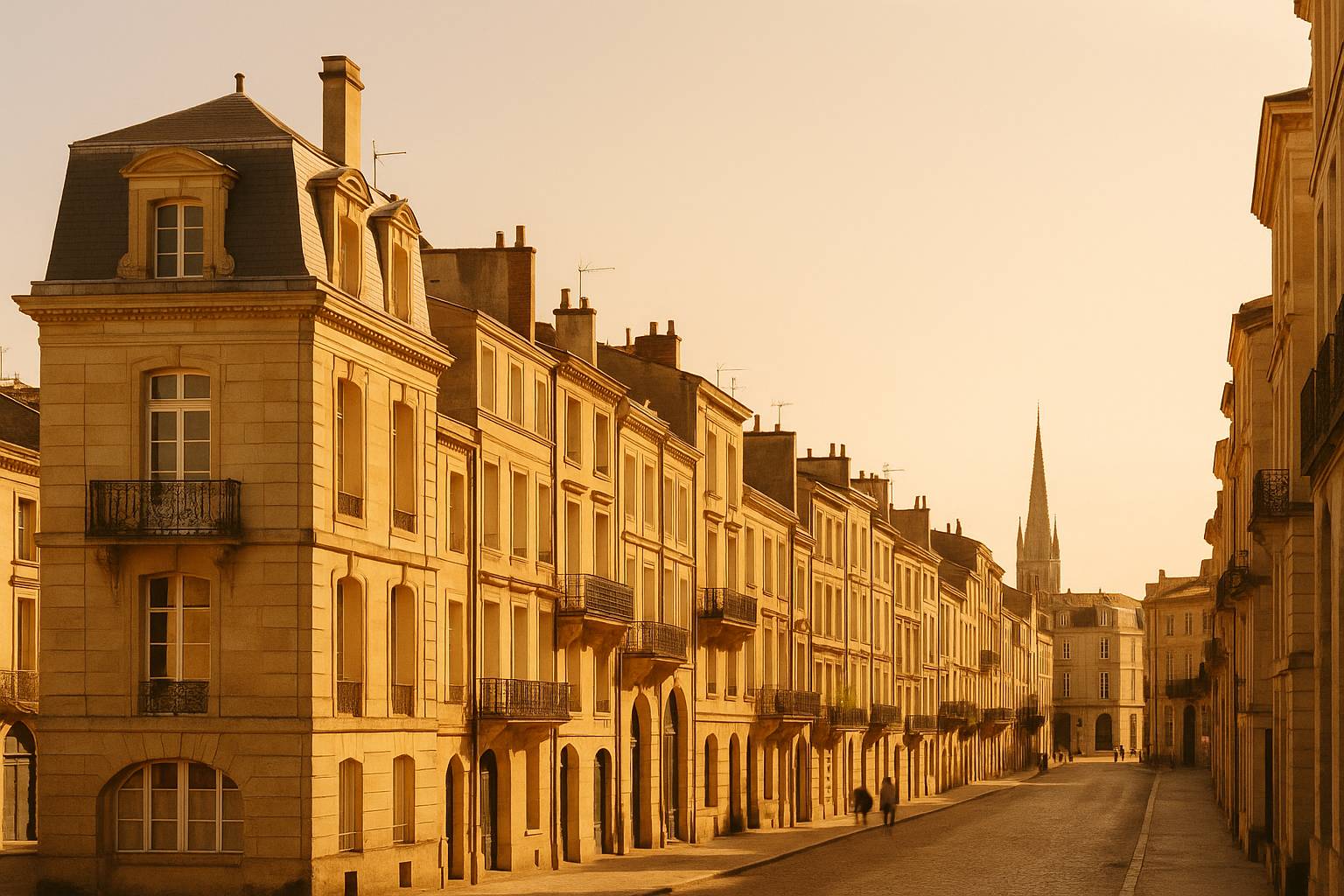
The classic choice. This is the golden triangle of eighteenth-century façades between Place de la Comédie, Place Gambetta and the Allées de Tourny. You are ten minutes on foot from Bar à Vin du CIVB (the wine council's own bar, and one of the best-value glasses in France), five minutes from the tram lines that feed Saint-Jean station, and surrounded by the kind of bistros — L'Univerre, Le Bouchon Bordelais — that take wine seriously without being pompous. It is the most convenient base, and it feels like Bordeaux at its most Haussmannian.
Saint-Pierre & the old town
South-east of the Triangle, wrapped around Place du Parlement and Place Saint-Pierre, this is the medieval quarter: narrow limestone streets, small squares, and a density of wine bars per square metre that borders on the absurd. Aux Quatre Coins du Vin, Le Wine Bar, Symbiose — all within a five-minute wander. It is livelier at night than the Triangle and slightly closer to the river, which matters when you are catching an early train.
Chartrons
The historical wine-merchant quarter, north along the river. For two centuries, the négociants of Chartrons shipped Bordeaux to the world from these warehouses; today the neighbourhood is quieter, more residential, full of antique dealers, the Cité du Vin at its northern end, and a Sunday morning market on the quays that is one of the great pleasures of the city. Choose Chartrons if you want mornings that feel more like living somewhere than visiting.
Saint-Jean & around the station
Practical rather than pretty. If your trip is really built around day trips — Saint-Émilion Monday, Médoc Tuesday, Sauternes Wednesday — sleeping ten minutes from the platform saves a genuine hour a day. The area around Rue Saint-Vincent-de-Paul has improved considerably in the last five years and now has real restaurants of its own.
Saint-Émilion by train, from your front door
Saint-Émilion is the single easiest world-class wine day trip in France. Trains leave Bordeaux Saint-Jean roughly every two hours; the journey takes thirty-five to forty minutes and drops you at a small station about a kilometre downhill from the medieval village. It is a pleasant walk up through the vines, or a five-euro taxi if the weather has other ideas.
Once you are there, the village is compact enough to walk end to end in twenty minutes, but the tastings themselves are the point. Book two estates in advance — one classified growth for the ceremony of it, one smaller family domaine for the honesty — and leave the middle of the day free for lunch at L'Envers du Décor or a wander through the monolithic church carved into the hillside. Return trains run until roughly nine in the evening, which means you can happily linger over a last glass without watching the clock.
A useful rule: book your Saint-Émilion tastings at least a week ahead. The famous names fill up, and even the smaller châteaux prefer to know you are coming.
Médoc, Graves and Sauternes without a car
Médoc is the harder one. The classified estates — Margaux, Pauillac, Saint-Estèphe — are spread along a thin ribbon between the Gironde estuary and the pine forests, poorly served by the local train, and generally require an appointment. This is the day when a small-group tour genuinely earns its keep. Companies leaving from central Bordeaux (Rustic Vines, Ophorus, and the tourist office's own coach) collect you around nine, visit two or three châteaux with tastings, include lunch, and deposit you back in town by six. The cost is usually less than the taxi fares you would otherwise accumulate, and someone else does the driving.
Graves and Pessac-Léognan, to the south, are more forgiving. Château Pape Clément and Smith Haut Lafitte both accept walk-in tastings on the right days and sit within a twenty-minute Uber of the city — you can genuinely do a half-day here and be back for lunch. Sauternes, further south still, is best done by train to Langon followed by a short taxi to Château Guiraud or Château de Rayne Vigneau; the sweet-wine estates tend to be welcoming to independent visitors in a way the Médoc grands crus are not.
- Saint-Émilion: train, independent, book ahead.
- Médoc: small-group tour from central Bordeaux.
- Pessac-Léognan / Graves: Uber or short taxi, half-day.
- Sauternes: train to Langon plus taxi, full day.
Tasting in Bordeaux itself
Between day trips, the city itself is a working wine region on foot. Start at the Bar à Vin du CIVB on Cours du XXX Juillet: two-euro glasses, curated by the regional wine council, changing weekly. It is a masterclass disguised as an aperitif. Follow it with a proper sit-down at Aux Quatre Coins du Vin in Saint-Pierre, where a self-service enomatic system lets you pour thirty-two wines by the sip, glass or half-glass and compare Pomerol against Fronsac at your own pace.
The Cité du Vin, at the northern end of Chartrons, deserves a half-day. It is not a museum in the dusty sense — it is a genuinely intelligent exploration of world wine culture, with a top-floor tasting room and one of the best views in the city included in the ticket. Time your visit for late afternoon so the panoramic tasting coincides with the sun setting over the Garonne.
For dinner, the wine-forward addresses worth planning around are Symbiose (small, seasonal, a serious list), Le Bouchon Bordelais (traditional and generous), and Garopapilles (chef's counter, half wine shop, half tasting menu). All three take reservations days in advance rather than weeks, which is unusual for cities of Bordeaux's growing reputation.
Why an apartment beats a hotel for a wine trip
Wine trips have a specific rhythm hotels are badly designed for. You come home carrying bottles — the estate gift, the one you bought at lunch, the case you shipped from Saint-Émilion that arrived at reception. You want to open one of them tonight, chilled, with the cheese you picked up at the covered market. You want a proper glass, not a hotel tumbler. You want to leave the Sauternes in the fridge overnight.
An apartment gives you all of that: a real kitchen, wine glasses, a fridge that holds more than a minibar tray, room to lay out the bottles you want to take home and decide which travel in the hold. It gives you a table where two or four of you can taste properly after dinner without a bar's noise. And it gives you mornings — coffee from a real machine, bread from the boulangerie downstairs, a slow start before the ten o'clock train. On a four-night trip these small comforts stop being small.
Practical logistics and timing
Bordeaux has a Mediterranean-ish rhythm the guidebooks understate. Most châteaux close on Sundays and many on Mondays; the best tasting days are Tuesday to Saturday. Harvest — usually the last two weeks of September and the first of October — is the most atmospheric time to visit, but also the busiest, and some estates suspend visits during picking. Late spring (May, early June) and October after harvest are the sweet spots for weather, availability and price.
Getting from the airport is straightforward: the tram line A now runs directly into the centre in about thirty-five minutes for a couple of euros. From Paris, the TGV takes just over two hours and drops you at Saint-Jean, from which the C tram carries you to the Grand Théâtre in twelve minutes. Almost every neighbourhood mentioned above is walkable from the tram; a car is not merely unnecessary, it is a liability given the pedestrian centre and paid parking.
One last note on quantities. Bordeaux tastings are generous, and châteaux visits often include four to six wines. Two estates a day is the honest maximum if you want to remember any of them. Three is a marketing fiction. Build your itinerary around fewer, better appointments and leave real time for lunch — which, in this region, is half of the point.
Tours & experiences to book
Small-group day trips solve the car problem for the harder-to-reach appellations. These are the ones we recommend most often to guests staying in our Bordeaux apartments — proper tastings, English-speaking guides, and pickup from central meeting points a short walk from the historic centre.
The Most Complete and Best Rated Tour of Bordeaux
"Bordeaux by bicycle: a 3-hour tour immersive experience"
Saint Emilion Day Trip with Sightseeing Tour & Wine Tastings from Bordeaux
Bordeaux Old Town Food and Wine Tour
Bordeaux bike tour "The Best of Bordeaux"
Professional - Bordeaux Wine and Cheese Tasting with a walking tour
Experiences offered via Viator — booking may earn Lavie Maison a commission, at no extra cost to you.
Stay in the neighbourhood: our Bordeaux apartments
Book direct with us — the same homes, up to 5% less than on Airbnb or Booking.
Lavie Maison: Studio Équipé
Les Chartrons
Lavie Maison: balneo Sauna
Les Chartrons
Lavie Maison Cozy Balneo Sauna
Les Chartrons
See all our Bordeaux apartments →
Compare with real hotel prices in Bordeaux →
Stay with Lavie Maison in Bordeaux
Our Bordeaux apartments sit in the neighbourhoods this guide recommends — the Triangle d'Or, Saint-Pierre, Chartrons — within a short walk of the tram lines that feed Saint-Jean station and the wine bars where the city's evenings really happen. Each one has a proper kitchen for the bottles you bring back, glassware that respects them, and a table large enough to taste at with the people you travelled with. They are designed by us, cleaned by us, and let you check in without a queue.
When you book direct on lavie.maison rather than through an OTA, you pay up to 5% less, deal with a human who actually knows the apartment and the city, and get honest advice on which châteaux to book, which train to catch and where to have your last dinner. It is the least glamorous part of a wine trip, and often the part that decides whether it was a good one.
Frequently asked questions
Where should I stay in Bordeaux for wine tasting without a car?
Stay in the historic centre — the Triangle d'Or, Saint-Pierre or Chartrons. All are within ten minutes of the tram network that connects directly to Saint-Jean station, from which trains reach Saint-Émilion in under 40 minutes and small-group tours to the Médoc pick up nearby.
Can you visit Saint-Émilion from Bordeaux without a car?
Yes, easily. Direct trains run from Bordeaux Saint-Jean to Saint-Émilion in 35–40 minutes, several times a day. The station is about a kilometre from the village — a pleasant uphill walk through the vines or a short taxi.
How do I visit the Médoc without a car?
The Médoc is genuinely hard to do independently — public transport is limited and the estates require appointments. Book a small-group day tour from central Bordeaux; they include transport, two or three château visits with tastings, and usually lunch, and drop you back in the city by early evening.
How many days do you need in Bordeaux for wine?
Three full days is the sweet spot: one for the city itself (Bar à Vin, Cité du Vin, wine bars), one for Saint-Émilion, and one for a Médoc or Graves tour. Four nights lets you add Sauternes or a slower final morning.
Is it better to stay in Bordeaux city or in the vineyards?
For most travellers, the city. Bordeaux sits at the geographical centre of the region with direct trains and tours to every major appellation, and its own wine bars and restaurants keep the evenings interesting. Sleeping in the vineyards is romantic but locks you into one sub-region and a car.
When is the best time to visit Bordeaux for wine tasting?
Late May to early June and the second half of October are ideal — good weather, châteaux fully open, and fewer crowds than harvest. Harvest itself (late September) is atmospheric but some estates suspend visits during picking. Most châteaux close Sundays and many Mondays.