Escapes · Haute-Savoie
Annecy travel journal: four days by the lake, 3h43 from Paris
A TGV from Gare de Lyon, a flat above the canals, two bikes and 1,280 € — notes from an August week beside the cleanest lake in Europe.
There are towns you visit and towns you audit. For anyone in our line of work, Annecy is both: you go for the lake, the old town and the reblochon, and you come home with a lesson in housing policy. Four days at the height of August, two people, a town-centre apartment booked online, bikes, three restaurants and a bank statement we are publishing as it stands. Here is what we saw, what it cost, and why the most alpine town in France increasingly resembles Paris — not in its architecture, in its regulation.
See our Paris apartments → Book direct — up to 5% less than Airbnb & BookingParis to Annecy: 3h43, and the temptation to stop in Lyon
The train leaves Paris Gare de Lyon and reaches the foot of the Alps in 3 hours 43 minutes, no changes. Sixteen to nineteen departures a day depending on the season: Annecy is, quite literally, within weekend range of Paris — closer in travel time than plenty of French villages on a Friday evening.
We broke the journey in Lyon, which is an excellent bad idea: you lose half a day and you gain the Musée des Confluences (12 € entry), that glass vessel moored at the spit where the Saône meets the Rhône. An extra hour in the origins gallery, a bar of Pralus chocolate on the way out, and the regional train heads east. You arrive in Annecy in the late afternoon, when the light flattens across the lake and the town has already started its apéritif.
The practical note: book the train early. On this line, the gap between a ticket bought six weeks ahead and the same ticket bought two days before runs into tens of euros — fares start around twenty and climb well past a hundred in high August.
The old town, or Venice without the lagoon
Annecy is called the Venice of the Alps, and for once the nickname is not entirely undeserved — provided you accept that the comparison is about water, not scale. The Thiou, which is not a river but the lake's outflow, cuts through the old town as a canal, runs beneath the arcades, splits around the Palais de l'Isle and heads off towards the Fier. That small triangular building from the 12th century — in turn a residence, a mint, a courthouse and a prison — is the most photographed postcard in Haute-Savoie. It earns the photograph.
What nobody tells you: Annecy's old town is small. Forty minutes of slow walking covers it. In August, between eleven and six, it is saturated — the arcaded streets shuffle forward at walking pace, every terrace is full, and the wicker baskets outside the shops spill onto the cobbles. The town surrenders the moment you stop trying to visit it during business hours. At eight in the morning the canals are yours. At ten at night too, with the façades burning in the water.
The market — Tuesday, Friday and Sunday mornings on rue Sainte-Claire — is worth the early alarm: farmhouse reblochon, tomme de Savoie, mountain charcuterie, blueberries in season. This is where you buy the lunch you will eat on the shore instead of queueing forty minutes for a table.
The lake, the only thing here with no price on it
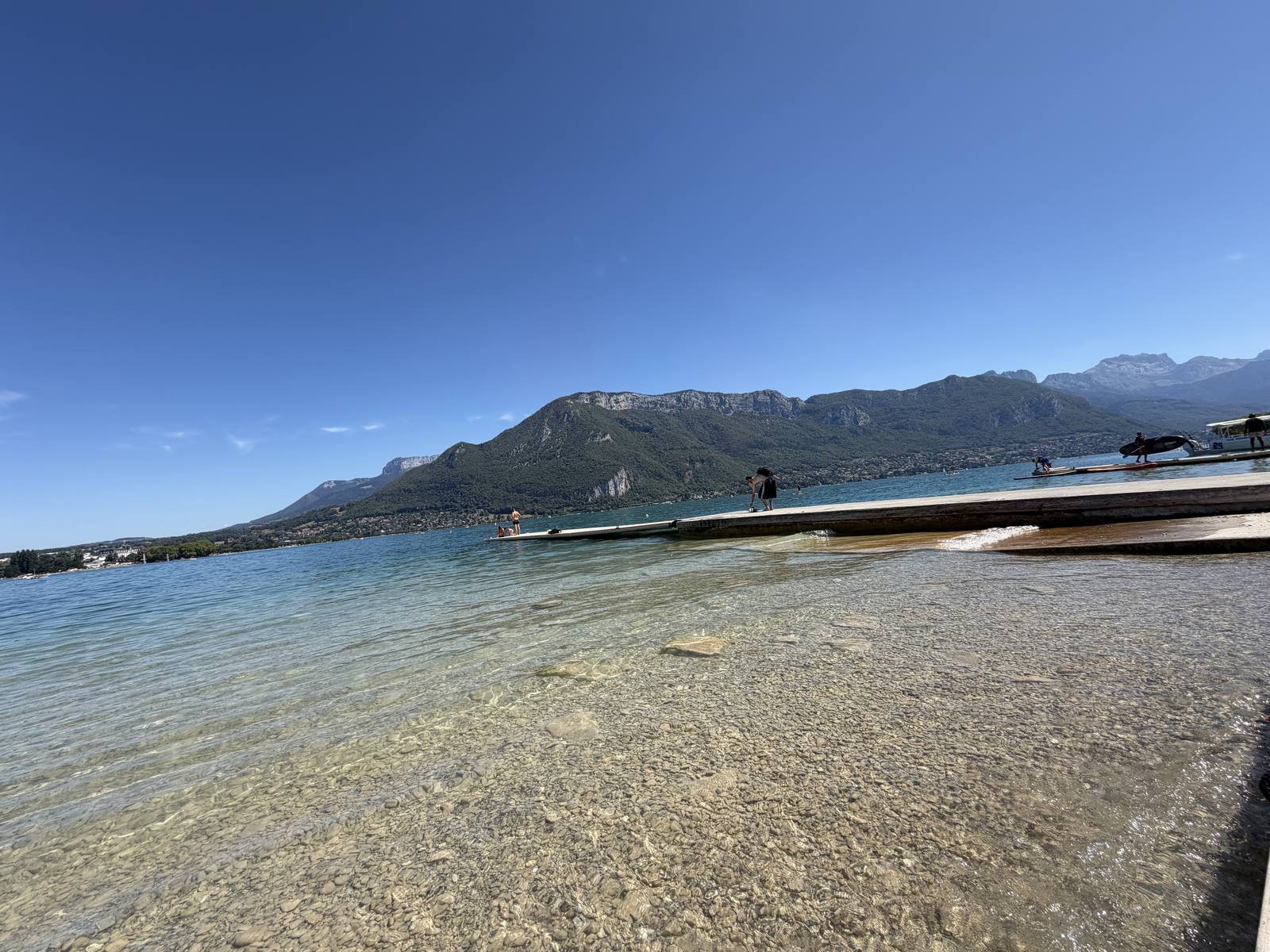
Let us put it plainly: Lake Annecy is abnormally clean. You can see the bottom through five metres of water. That is the result of a political decision taken in 1957, when the lakeside communes financed a sewer collector running the full circumference of the lake so they could stop discharging into it — one of Europe's first large-scale lake clean-ups. Seventy years later you swim in it, and it costs nothing.
The public beaches — Impérial, Marquisats, Albigny — are ten minutes' walk from the centre. Wooden pontoons run out over water that stays cold even in August, and the view slides south towards La Tournette and the Dents de Lanfon. Standing on the Pâquier, the vast lawn opening onto the water, you understand the town's property prices in about one second.
Cycling the lake: the best money we spent
Thirty-five euros at Vélonecy, the municipal rental service near the station. It was, by a distance, the best value of the four days. The voie verte along the western shore follows a disused railway line all the way south to Doussard: roughly thirty kilometres, car-free, flat, shaded in places, with the lake permanently on your left.
Allow two easy hours to Duingt and its castle on the headland, four for the full circuit if you return along the eastern shore — which runs on the road and asks for more attention. The lazy and highly recommended variant: ride to Saint-Jorioz or Duingt, swim, have lunch, and come back by boat with the bike on board, courtesy of the Compagnie des Bateaux du lac d'Annecy.
Where we ate
Three addresses, four days, not a single reservation made in advance — which in August counts as knowing recklessness.
Le Vénitien, 9 bis rue Royale — the terrace sits on the canal, off the main flow of the street, which is all you ask of a terrace in August. Simple cooking, local produce, quick service. 77.10 € for two, lunch with wine.
Dip Honest Food, 9 rue de la Gare — Mediterranean interior, non-stop service from 8.30am to 11pm, and a largely plant-based menu that is the exact counterpoint to a fondue. This is where you repair the previous evening. 70.80 € for brunch for two, then 7.50 € for coffee the next day.
Chez Jean, inside the station — the concourse newsagent, where you buy the sandwich and the bottle of water for the way home. 25.79 €. We list it because an honest journal lists the station too.
What we did not do, and should have: book a proper Savoyard table a week ahead. In August the good houses of the old town are full at lunch and at dinner, and you fall back on the first free terrace — which is rarely the best one.
What four days in Annecy actually cost
Here are the exact figures, bank statement in hand, for two people from 7 to 11 August 2026 — that is, at the absolute peak of the season.
- Accommodation — a two-bedroom flat in the centre with a view, booked on Airbnb: 1,052 € for 4 nights, or 263 € a night. (Originally 1,278.50 € for 5 nights, cut to 4 at the host's request, 226.30 € refunded.)
- Restaurants and cafés — 181 € in total across four days, eating twice on the move and once from the market.
- Bikes — 35 € for two, for the whole stay.
- Musée des Confluences (the Lyon stopover) — 12 €.
- Total excluding travel — 1,280 € for two, or 320 € a day.
The lake, the beaches, the greenway, the old town and the Pâquier appear nowhere on that list: they are free. Almost the entire cost of Annecy in summer is the bed. Which brings us to the interesting part.
What Annecy owes Paris
Two hundred and sixty-three euros a night for two bedrooms in the centre is not a calendar accident. It is the price of a market that is tightening, and it is tightening because Annecy decided to apply — and then harden — the rulebook written in Paris.
A reminder of the Paris rulebook: turning a home into a permanent short-term rental requires a change of use, granted only against compensation — creating replacement housing elsewhere — while a primary residence may be let for 120 days a year under a registration number. Paris imposed that architecture more than a decade ago, and it has been copied widely.
Annecy took it and added what Paris never dared: a hard number. The regulation voted by Grand Annecy on 13 February 2025, in force from 1 June that year, sets a quota of authorisations across the 27 communes of the agglomeration — 2,660 tourist rentals from June 2026, against roughly 6,400 recorded in 2024. Close to 3,700 homes therefore leave the tourist rental market. The zoning is brutally clear:
- Zone A — old town, Courier, Marquisats: 460 authorisations. This is where you want to sleep. This is where there are fewest.
- Zone B — lakeshore, inside the ring road, station district: 1,000.
- Zone C — the rest of the commune: 1,200.
Add that authorisations run for four years, are non-transferable, and are limited to one per person or company, and you have the most restrictive regime in France for a town of this size. Since 20 May 2026, the Le Meur law layers the national obligation on top: every tourist rental must display a thirteen-digit registration number on the listing, whatever the platform.
Paris invented the mechanism; Annecy turned it into arithmetic. In both cities the conclusion for the traveller is identical: the good, well-located, properly declared apartment has become a rare object, and it books early.
For a traveller this translates into three habits. First, check the registration number on the listing: its absence flags a property that can vanish from the market between your booking and your arrival. Second, book earlier than you would elsewhere — the central supply is not coming back. Third, widen the map: Sévrier, Saint-Jorioz, Veyrier-du-Lac and Menthon-Saint-Bernard are fifteen minutes from the centre by bike or bus, and rates drop sharply — in the order of 110 to 160 € a night in high summer against 180 to 250 € in town.
There is one last historical detail that makes the kinship faintly uncanny. Annecy has only been French since 1860: the Treaty of Turin attached Savoy to France under Napoleon III. In that same decade, in Paris, Haussmann was cutting the city open and giving it the face we know. The two towns are contemporaries in their modern form — except that Paris buried the Bièvre beneath its boulevards, while Annecy kept its Thiou in the open air. Walking the canals today, you can measure exactly what Paris lost that day.
When to come
August is the worst window, and it is the one we chose: hot, full, expensive. The town is beautiful anyway, but you share it.
June and September are the two obvious answers — the lake is swimmable from mid-June to late September, terraces are free, rates fall by about a third. May is superb and green, with snow still on La Tournette, but the water is cold. December is worth the trip for the Venetian Christmas market and an empty old town. In January and February the town works as a base camp: La Clusaz and Le Grand-Bornand are forty minutes away by bus.
And a weather warning: we had open blue sky on the Friday and a lid of cloud on the Saturday, same place, same hour. This is the mountains. Pack a layer and a plan B — which here is called the Château d'Annecy, or the museum inside the Palais de l'Isle.
Tours and experiences to book
A boat tour of the lake, paragliding off the Col de la Forclaz, canyoning in the Aravis, Savoyard cheese tastings: the Annecy classics need booking, and in August they need booking early.
Annecy Food Tour – A Full French Meal Experience by Do Eat Better
Canyoning Annecy Angon Discovery
Annecy Segway Tour - 1h
Annecy Segway Tour - 1h30
Annecy Segway Tour - 2h
Private Market Tour and Cooking Class in Annecy with a Local
Experiences offered via Viator — booking may earn Lavie Maison a commission, at no extra cost to you.
Where to stay in Annecy: our addresses
Impérial Palace
★★★★
The Belle Époque liner on the Pâquier, feet in the water and a casino downstairs — Annecy's historic address.
View hotel →
Les Trésoms Lake & Spa Resort
★★★★
Up on the hillside above town: a plunging view of the lake, a spa, and La Rotonde, Michelin-starred since 2021.
View hotel →
Rivage Hôtel & Spa
★★★★
Contemporary, on the shore, ten minutes' walk from the old town — the comfort-versus-location compromise.
View hotel →
Partner links — booking may earn Lavie Maison a commission, at no extra cost to you.
Before or after Annecy: our apartments in Paris
Book direct with us — the same homes, up to 5% less than on Airbnb or Booking.
Lavie Maison | Montmartre Cosy Studio
Opéra – Grands Boulevards
Lavie Maison AC Fontaine Studio
Auteuil
Lavie Maison : AC & Terrace
Auteuil
See all our Paris apartments →
Compare with real hotel prices in Paris →
Staying in Paris with Lavie Maison
Most travellers heading to Annecy come through Paris — it is the entry point, it is where the Gare de Lyon train leaves from, and it is often where the trip ends. Our Lavie Maison apartments are built for those nights: in neighbourhoods people actually live in, with a real kitchen, linen changed for you, and an address ten minutes from Gare de Lyon when the TGV leaves at 7.20am.
We apply in Paris exactly what we suggest you check in Annecy: declared properties, authorisations in order, and someone who answers the phone. It is the invisible part of the job, and it is the part that keeps a stay from being cancelled three days before arrival.
Booking directly on our Paris page is up to 5% cheaper than the same apartment on Airbnb or Booking.com, because we pay no platform commission on a direct reservation. Send us your dates and we will come back within one working day with an honest number and two or three apartments that suit the stay. When you are ready, book direct and we will handle the rest.
C'est Lavie.
Frequently asked questions
How long does the train from Paris to Annecy take?
3 hours 43 minutes on a direct TGV from Paris Gare de Lyon, with no changes. Depending on the season, sixteen to nineteen services a day run on the line. Fares start around twenty euros when booked several weeks ahead and easily exceed a hundred at the last minute in August.
What budget should I plan for a weekend in Annecy?
Our four-day stay for two, in high August, cost 1,280 € excluding travel: 1,052 € for accommodation (263 € a night for a two-bedroom in the centre), 181 € on restaurants, 35 € on bike hire. Outside July and August, expect roughly a third less on lodging. The lake, the beaches and the greenway are free.
Do I need a car in Annecy?
No, and it is actively unhelpful: the centre is pedestrianised and parking is expensive and saturated in season. A bike is the right vehicle — around 35 € to hire for a stay from Vélonecy — combined with the lake boats and the bus network out to the shoreline villages.
Can you still rent an Airbnb in Annecy in 2026?
Yes, but supply is shrinking sharply. Grand Annecy caps tourist rentals at 2,660 authorisations across its 27 communes from June 2026, against roughly 6,400 in 2024, with only 460 slots in zone A (old town, Courier, Marquisats). Always check that the listing displays the thirteen-digit registration number, mandatory since 20 May 2026, and book earlier than you would elsewhere.
Where can I stay more cheaply than central Annecy?
Along the shore, fifteen minutes away by bus or bike: Sévrier, Saint-Jorioz, Veyrier-du-Lac or Menthon-Saint-Bernard. Summer rates there run around 110 to 160 € a night against 180 to 250 € in town, and you are often closer to a beach.
Can you swim in Lake Annecy?
Yes — it is one of the cleanest lakes in Europe, thanks to the sewer collector built around it from 1957 onwards. The public beaches in town — Impérial, Marquisats, Albigny — are free or very cheap, and the water is swimmable from mid-June to late September, while staying cold even in August.