Family Guide · Nice
Family Apartment in Nice, France: Where to Stay by the Sea with Kids
A local editor's guide to staying in Nice with children — from the Promenade to Vieux-Nice, and why an apartment beats a hotel room.
Nice is one of the easiest cities in Europe to travel with children — a walkable seafront, a compact old town, gelato on every corner, and a climate that forgives late flights and long naps. But the city rewards travellers who choose their base carefully. A family apartment in the right arrondissement can turn a good holiday into a genuinely restful one.
See our Nice apartments → Book direct — up to 5% less than Airbnb & BookingWhy Nice works so well with children
Nice is a city built for slow days. The airport sits fifteen minutes from the centre by tram, the seafront is flat and pram-friendly, and almost everything a family needs — a bakery, a pharmacy, a playground, a pebble beach — is within a ten-minute walk of the historic core. Unlike Paris or Rome, you rarely have to plan a day around logistics. You wake up, you wander down to the Promenade, and the city arranges itself around you.
The climate is the second gift. From April to late October, Nice offers reliable sun without the humidity of the Italian coast or the mistral of Marseille. Evenings stay warm enough to eat outside; mornings are cool enough to walk to a museum without a meltdown. Children who normally resist "sightseeing" tend to accept Nice's rhythm — beach, lunch, siesta, gelato, sunset — with unusual grace.
Finally, Nice is genuinely bilingual with tourists. Menus, museum signage and pharmacy staff will meet you halfway in English, which lowers the stress bar for parents travelling without much French. It is a city where you can be an inexperienced traveller with two small children and still feel competent by day three.
The best neighbourhoods for a family stay
Where you sleep in Nice matters more than in most cities, because the character shifts sharply from one street to the next. Broadly, four areas suit families, each with a distinct trade-off between charm, quiet and proximity to the sea.
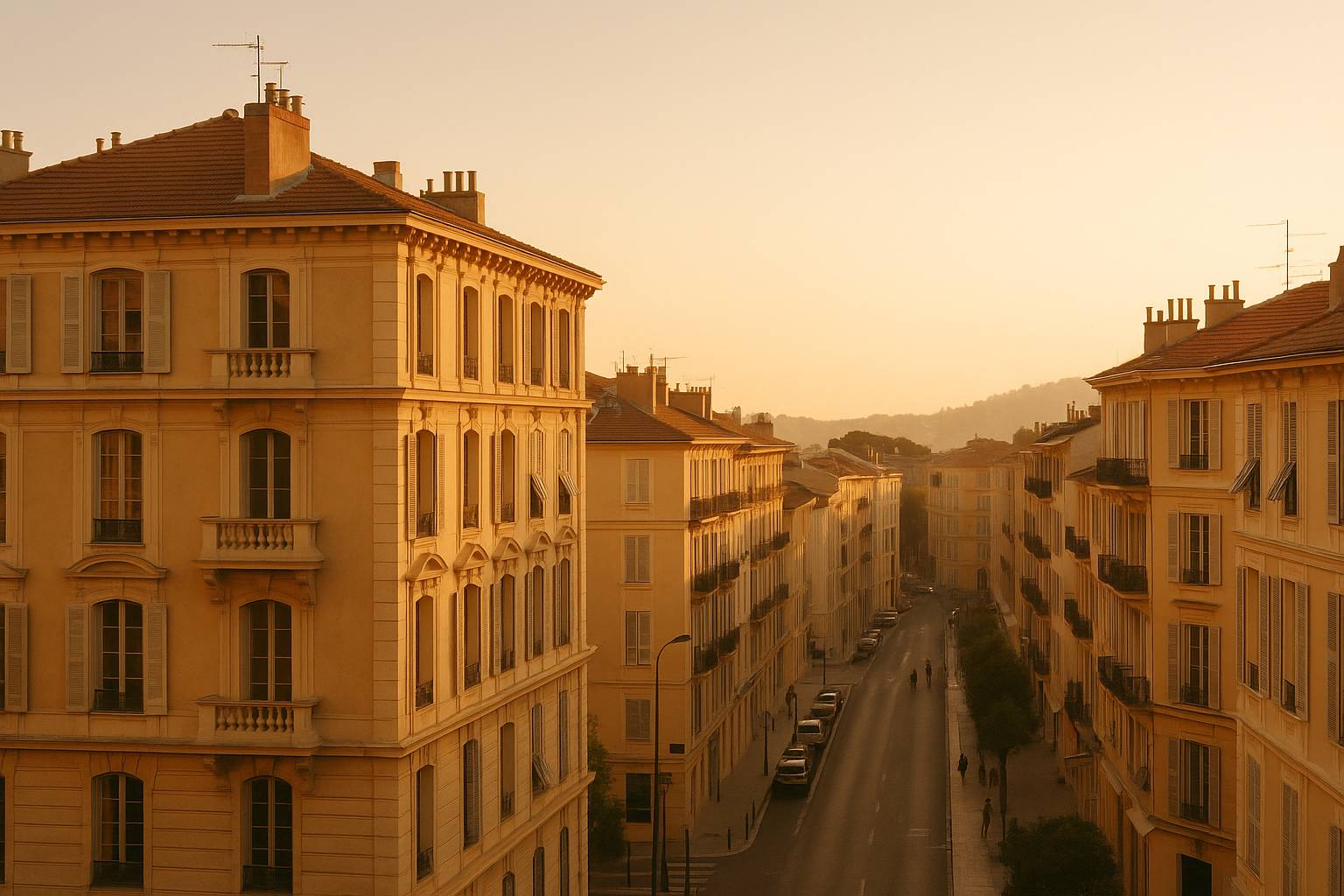
Carré d'Or — the elegant grid between Place Masséna and the Promenade — is our default recommendation for a first visit. Streets are wide, buildings are Haussmannian, and you are five minutes from both the beach and the tram. It is calm at night, safe to walk with a sleeping toddler at 10 pm, and rich in bakeries and small supermarkets. The trade-off is price: this is the most sought-after postcode in the city.
Vieux-Nice (the old town) is romantic and photogenic, but honest advice: it can be loud until after midnight in summer, and the lanes are too narrow for a double buggy. Choose it only if your children are older, sound sleepers, or you have a courtyard-facing apartment on an upper floor. Le Port, just east of the castle hill, is quieter, has excellent seafood, and feels like a village — a lovely choice for a second visit. Musiciens and Libération, north of the station, trade sea views for local life, a superb daily market, and noticeably lower rents.
- First trip, young kids: Carré d'Or or western Jean-Médecin.
- Older children, romance: Vieux-Nice, upper floor, courtyard side.
- Longer stay, real neighbourhood feel: Le Port or Libération.
- Avoid: anything directly on Rue Masséna (pedestrian bar street) with small children.
Beaches, pebbles and swimming with children
Nice's beaches are famously pebbled, not sandy, and this catches many families by surprise. The pebbles are smooth and rounded — no cuts — but they are hot underfoot in July and August, and uncomfortable to sit on without preparation. Bring or buy on arrival: two pairs of aqua shoes per child, an inflatable wedge or padded mat, and a small umbrella. Once equipped, the beaches are excellent: the water shelves gently, is exceptionally clear, and lifeguards patrol the public sections from June to September.
For families, the stretch between Plage Beau Rivage and Plage Blue Beach is the sweet spot — close enough to the old town to walk home for a nap, quiet enough that toddlers can potter. Further west, Plage Carras and Plage Magnan are wider, less crowded, and popular with local families; the tram or a short taxi gets you there in ten minutes. Private beach clubs ("plages privées") rent loungers with parasols from around €22 per adult per day and are worth it once with children — the shade, the toilets and the on-beach lunch service transform a beach day.
A note on safety: the drop-off can be sudden two or three metres from shore, and there is often a modest current when the wind turns. Younger children should wear armbands or a vest even in shallow water, and the yellow-flag days (roughly one in five in shoulder season) really do mean caution.
Vieux-Nice with a buggy (and without tears)
The old town is the emotional centre of any Nice trip, and it is possible to enjoy it with young children — but with strategy. Go early. Between 8.30 and 10.30 am, the Cours Saleya flower market is in full swing, the lanes are cool and quiet, and you can move a buggy without apologising every twenty seconds. This is the moment for socca at Chez Pipo or Chez René, a wander past the yellow façade of the Palais Lascaris, and a first gelato at Fenocchio — the tomato-basil and violet flavours are theatre for kids.
By late morning the crowds arrive, and Vieux-Nice becomes hard work with wheels. Retreat uphill to the Colline du Château: there is a free lift from the eastern end of the Quai des États-Unis, a large playground at the top, a waterfall, shade, and the best view of the Baie des Anges. Families routinely spend three hours up there and forget they meant to "do" a museum.
Return to the old town in the evening, after 7 pm, when the light softens and the restaurant terraces open. Children are welcomed everywhere — Niçois dining culture is unfussy and generous — and a pissaladière shared between two adults and a small child is a rite of passage.
The Promenade des Anglais, day by day
The Promenade is Nice's living room. Seven kilometres of seafront pavement, wide enough for buggies, joggers, scooters and grandparents to coexist. If you rent an apartment near it, you will use it every day, and each use will feel slightly different.
Mornings belong to families and runners: quiet, cool, with the pastry shops open behind you and the sea flat. Rent scooters or bikes from the municipal Vélo Bleu stations (children over about seven can manage the ride to the port and back). Late afternoons bring the local ritual of a swim after school; by sunset, the west-facing benches near the Négresco fill up with people simply watching the light turn pink over the Estérel. This is the moment to buy a scoop of gelato and let the day end itself.
The Promenade is the reason a family apartment in Nice feels different from a hotel. You step out, you walk fifty metres, and the holiday is already happening.
Things to do with children beyond the beach
Nice has more depth than its beach reputation suggests. The Parc Phoenix, near the airport, is a botanical garden with a lake, flamingos, an enormous greenhouse and shaded lawns — half a day easily, and cheap. The Musée Matisse and the surrounding Cimiez park suit slightly older children: the museum is small enough not to exhaust anyone, and the olive grove outside is perfect for a picnic and a run-around. The Musée Océanographique is technically in Monaco, but the twenty-minute train ride along the coast is itself an event, and the aquarium is genuinely world-class.
For rainy days — rare, but they happen in spring — the Musée National du Sport in the Stade Allianz Riviera has interactive exhibits that keep restless nine-year-olds occupied for two hours. Closer to the centre, the Galerie Lympia at the port hosts child-friendly contemporary shows and is free.
Day trips are where Nice really shines as a family base. Villefranche-sur-Mer is fifteen minutes by train and has an actual sandy beach. Èze village, high on its rock, is a morning's outing with older children. Antibes has a Picasso museum and a proper sand beach at La Gravette. Cannes is close but skippable with young kids; Monaco is worth one day for the aquarium and the changing of the guard.
Practical tips: transport, markets, medical
The tram is your friend. Line 2 runs from the airport to the port via Jean-Médecin and is buggy-accessible, air-conditioned and cheap (€1.70 a ride, free for under-fours). A ten-ride carnet pays for itself in two days. Avoid renting a car unless you plan serious day trips inland; parking is expensive and Vieux-Nice is closed to non-residents.
For groceries, the Cours Saleya food market runs Tuesday to Sunday morning and is a great first stop for produce, cheese and Niçois specialities (socca flour, olive tapenade, candied lemons). For everyday shopping, the Monoprix on Avenue Jean-Médecin and the Casino on Rue de France cover nappies, formula, sun cream and wine at civilised hours. The Marché de la Libération, further north, is the local's market — cheaper, less scenic, more fun.
Pharmacies are everywhere and the staff speak enough English to handle a fever or a jellyfish sting. The Hôpital Lenval is the paediatric hospital, well-signposted, with an English-speaking emergency service. Tap water is safe and pleasant; sun cream should be SPF 50 for children between May and September without argument.
Tours & experiences to book
A few family-friendly experiences that pair well with an apartment stay in Nice — boat trips along the Baie des Anges, e-bike tours of the Promenade, and day excursions to Monaco, Èze and the perched villages. Book ahead in July and August; shoulder-season availability is usually generous.
NO DIET CLUB - Unique Local Food in Nice !
★ Walking Tour of Old Nice and Castle Hill
Nice City Segway Sightseeing Tour
The Best of the French Riviera Small group Guided Tour from Nice
Nice: Panoramic Guided Tour in an Open-Top Electric Car
Provence Wine Tour - Small Group Tour from Nice
Experiences offered via Viator — booking may earn Lavie Maison a commission, at no extra cost to you.
Stay in the neighbourhood: our Nice apartments
Book direct with us — the same homes, up to 5% less than on Airbnb or Booking.
Lavie Maison | Sauna & Hot Tub
Grosso
Lavie Maison - Hot Tub AC and Sauna
Carré d'Or
Lavie Maison | Hot Tub Seaside Flat
Grosso
Compare with real hotel prices in Nice →
What to look for in a family apartment in Nice
Not every Nice apartment is set up for children, and the listings can be misleading. Before booking, check five things honestly. Air conditioning is non-negotiable from June to September; a fan is not enough when the mercury sits at 30°C for a week. A real kitchen — not a hotplate in a cupboard — changes everything with kids, from midnight bottles to a home-cooked pasta after a long beach day. A washing machine saves a suitcase's worth of packing. A courtyard-facing bedroom matters more than a sea view if you want anyone to sleep past 6 am. And a lift, in a city of five-storey Belle Époque buildings, is worth the modest premium once you have counted the buggy, the beach bag and the sleeping toddler.
Space, of course, is the deeper reason families choose apartments over hotels. Two hotel rooms cost more than one apartment, force you to whisper after 8 pm, and give you nowhere to sit down together with a glass of wine while the children draw at the table. In an apartment, the holiday belongs to the whole family, not just to the hours between meals.
Stay with Lavie Maison in Nice
Our Nice apartments are chosen with exactly this brief in mind: quiet buildings within ten minutes of the Promenade, proper kitchens, real air conditioning, family-sized beds, and hosts who answer messages in under an hour. Several sleep four to six comfortably; all have washing machines, lifts where the building allows, and honest listings with courtyard-versus-street disclosure.
When you book direct with Lavie Maison, you pay up to 5% less than the same apartment on Airbnb or Booking.com — the platforms take a large commission we would rather pass back to you. Direct guests also get earlier check-in when possible, a proper local guide on arrival, and a real person on WhatsApp for the length of your stay. No middleman, no algorithm, no surprise cleaning fees on the final screen.
Nice with children is one of the most forgiving family trips in Europe. Choose the right base, and the rest of the holiday takes care of itself.
Frequently asked questions
Is Nice, France a good destination for families with young children?
Yes — arguably one of the easiest in Europe. The seafront is flat and buggy-friendly, the old town is compact, the climate is mild from April to October, and healthcare and pharmacies are excellent. The main adjustment is the pebble beaches, which need aqua shoes and a padded mat.
Which neighbourhood in Nice is best for a family apartment?
For a first trip with young children, the Carré d'Or (between Place Masséna and the Promenade des Anglais) is ideal: quiet, elegant, five minutes from the sea. Older families enjoy Vieux-Nice for its atmosphere, while Le Port and Libération suit longer, more local stays.
How many bedrooms do we need for a family of four in Nice?
A two-bedroom apartment (around 55–70 m²) is comfortable for two adults and two children. If you have three children or are travelling with grandparents, look for a three-bedroom or a two-bedroom with a proper sofa bed in a separate living area — and confirm the apartment has air conditioning and a lift.
Are Nice beaches safe for children if they're pebbled?
Yes, but come prepared. The pebbles are smooth (no cuts) but hot in summer and uncomfortable underfoot — bring aqua shoes and a padded mat, or rent loungers at a private beach club. The water shelves gently and is lifeguarded in season; younger children should wear armbands as the drop-off can be sudden.
Do we need a car in Nice with kids?
No. The tram from the airport reaches the centre in fifteen minutes, and everything family-relevant is walkable or a short tram ride. Rent a car only if you plan multiple day trips into the arrière-pays or the Verdon; for coastal excursions to Villefranche, Èze, Antibes or Monaco, the train is faster and cheaper.
Is it cheaper to book a Nice apartment direct or through Airbnb?
Booking direct with the operator is almost always cheaper. Platforms like Airbnb and Booking.com add service fees and take a commission from the host. Lavie Maison passes that saving back to guests who book direct — typically up to 5% less than the same apartment on the OTAs, with the same or better flexibility.