Long Stays · Nice
Monthly Apartment Rental in Nice: The Long-Stay Guide to Winter Sun, Remote Work & Slow Riviera Living
Everything a 28-night guest needs to know before settling into the Côte d'Azur.
Nice is one of the few European cities where a month doesn't feel long enough. The light stays soft into December, the sea is walkable from almost anywhere, and daily life — the market at Cours Saleya, an espresso at the counter, a swim before work — reorganises itself around you within a week. This guide is written for the person who has decided, or is about to decide, to stay properly: 28 nights, six weeks, a whole winter. It covers where to base yourself, what a fair monthly rent looks like, how the remote-work practicalities actually work, and what to ask before you sign.
See our Nice apartments → Book direct — up to 5% less than Airbnb & BookingWhy Nice works so well for a monthly stay
Nice is built to a human scale. From the seafront at the Promenade des Anglais to the foot of the hills at Cimiez, the whole city fits inside a walk of about forty minutes. That geography is why a month here feels different from a month in Paris or Barcelona: you are not commuting through your own holiday. Groceries, the beach, a co-working space, a Michelin bistro and a Roman ruin can all sit within a fifteen-minute radius, which is exactly what long stays need.
The second reason is climate. Nice averages around 300 sunny days a year and rarely drops below 8 °C, even in January. For anyone escaping a grey northern winter, a 28-night stay between November and March buys back an extraordinary amount of daylight and outdoor time. The third reason is connectivity: Nice Côte d'Azur is France's third-busiest airport, with direct flights to most of Europe, London and increasingly New York and Dubai, plus a tram straight into town for €1.70.
Finally, Nice has quietly become one of the more serious remote-work cities on the Mediterranean. Fibre is widespread, English is common in cafés and coworking spaces, and the time zone works for both London and the US East Coast. A monthly rental here is not a compromise between holiday and work — it's genuinely both.
What a monthly apartment rental in Nice actually costs
Long-stay pricing in Nice moves with the season more than most cities. The rule of thumb: a well-located, properly furnished one-bedroom for a 28+ night stay ranges from about €1,900 to €3,200 per month in the low season (November to March), €2,400 to €3,800 in the shoulder (April, May, October), and €3,500 upward in July and August, when short-let demand pushes monthly availability down sharply.
Studios in Le Port or the eastern edge of the Old Town can dip to €1,500–€1,800 in deep winter. Two-bedrooms in the Carré d'Or or with a real sea view sit closer to €3,500–€5,000. Anything advertised well below these bands in a central address usually means a ground floor on a noisy street, a fifth-floor walk-up, or a photo set that is being generous with the word "renovated".
What matters more than the headline rate is what's included. On a monthly booking you should expect utilities, wifi, weekly or fortnightly housekeeping, linen and towels, and city tax to be either included or clearly itemised. Ask specifically about electricity in winter — badly insulated old-town flats with electric heaters can add €150–€250 a month you didn't budget for.
- Studio, long stay, low season: ~€1,500–€2,000
- One-bed, central, long stay: ~€1,900–€3,200
- Two-bed with view or terrace: ~€3,200–€5,000
- Add ~20–35% for shoulder season, ~50–80% for July/August
The best neighbourhoods for a long stay in Nice
Carré d'Or and Musiciens
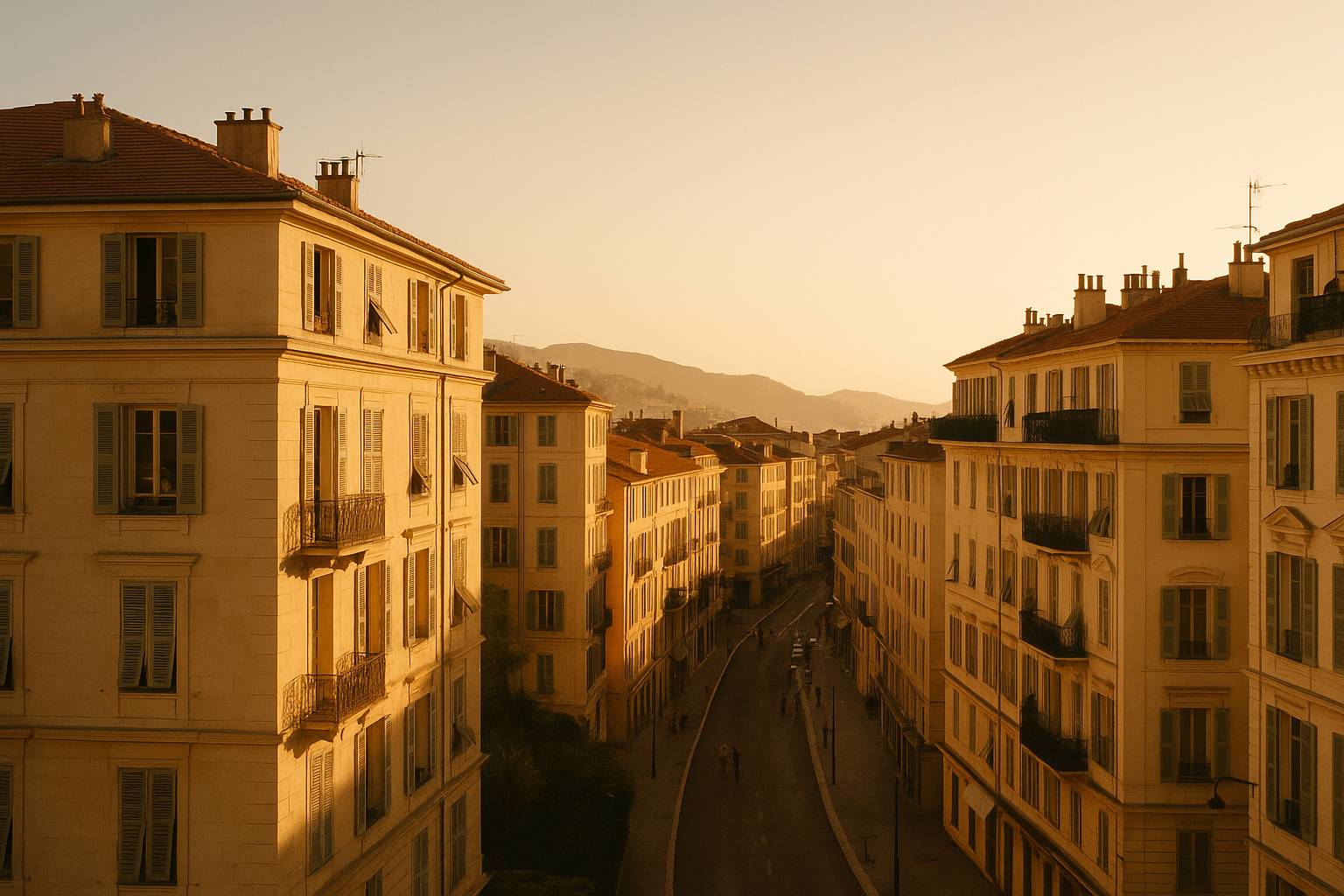
The grid of Haussmann-style streets between Place Masséna and the Boulevard Victor Hugo is where most long-stay guests are happiest. Buildings have lifts, ceilings are high, and you are a five-minute walk from both the sea and the tram. It is the quietest of the central options at night and the easiest for anyone travelling with a partner, a laptop and a slight allergy to stag parties.
Vieux Nice (the Old Town)
Extraordinary for a week, demanding for a month. The lanes are beautiful, the market is on your doorstep, and every second doorway is a wine bar. The trade-off is noise until 1 a.m. on weekends, no lifts in most buildings, and cars that cannot reach your door. Choose it if you are romantic about city living and a light sleeper only in principle.
Le Port and Riquier
The most interesting neighbourhood in Nice right now. The port itself has been reworked, the restaurant scene is the city's best per square metre, and you are a short walk from both the Old Town and the coastal path toward Villefranche. Prices are still 10–20% below the Carré d'Or.
Cimiez and Mont Boron
Residential, leafy, quieter. Cimiez suits families and anyone who wants a garden and the Matisse museum on their morning walk; Mont Boron suits runners and view collectors. Both need a bus or a bike for daily life, which some long-stayers love and others find tiring by week three.
Monthly apartment vs hotel or short-let Airbnb
For any stay past about ten nights, the maths turn against hotels quickly. A modest 3-star in central Nice sits around €140–€180 a night in shoulder season, which is €4,200–€5,400 for 30 nights — without a kitchen, without laundry, and with the small daily friction of housekeeping needing to enter the room. A well-run monthly apartment at €2,500–€3,000 delivers more space, a real kitchen, a washing machine and a front door that is yours.
Against a standard short-let Airbnb, the differences are subtler but real. Monthly-focused operators price differently (weekly rates fall as the stay lengthens), tend to include utilities and cleaning in the quoted figure, and — importantly in Nice — comply with the city's registration rules for stays over 30 days, which protects you from last-minute cancellations when a host realises they've mis-listed a property. Ask for the registration number; a serious operator will send it without hesitation.
A month in a good apartment costs roughly what two weeks in a comparable hotel would. The second fortnight is, in effect, free — you're only paying for the privacy and the kitchen.
Remote work from Nice, in practice
Wifi in central Nice apartments is usually fibre, and most serious hosts publish speed test screenshots on request. Anything under 100 Mbps down / 20 Mbps up is worth questioning for a working stay. Ask also about the desk: a proper table, a decent chair and enough natural light matter more over 28 days than any design detail.
If you prefer to work outside the flat, Nice has a growing coworking scene. WeWork on Avenue Jean Médecin, Kwerk near the port, and smaller independent spaces like Le Patio and 27 Delta all offer day passes around €25–€30 and monthly memberships from €250. Cafés with tolerable laptop culture cluster around Rue Bonaparte and the Liberation market — Emilie & the Cool Kids, Café Bianca, Malongo.
The rhythm most remote workers settle into looks like this: swim or walk the Promenade before 9, deep work from 9 to 13, long lunch, a slower afternoon of meetings, then an apéro and dinner that starts at 20:30 like a local. It is genuinely one of the more sustainable working setups in Europe.
Winter sun in Nice: what November to March actually looks like
Winter is Nice's underrated season and, for monthly rentals, its most interesting one. December through February typically bring daytime highs of 13–16 °C, cold-crisp mornings, and long stretches of clear light that photographers love. It rains, but in bursts of a day or two rather than the northern European drizzle. You will wear a jacket in the morning and often carry it home.
The city empties agreeably. Restaurants that require a two-week booking in July take walk-ins in January. The Promenade belongs to runners and old men on benches rather than to scooters. Carnaval in February and the Fête du Citron in nearby Menton give the season two genuine events. Flights are cheap, and monthly rents can sit 30–40% below their summer equivalents.
The honest caveats: the sea is too cold for most people to swim (though hardy locals do, daily), some smaller museums close on Mondays and Tuesdays, and heating in older buildings can be uneven. This is where a well-run apartment earns its rent — proper double glazing and reversible air-conditioning matter enormously in a Niçois January.
What to check before booking a monthly rental in Nice
The listing photos will tell you about the taste of the owner. The following list tells you whether you'll actually enjoy the stay.
- Floor and lift. Anything above the second floor without a lift is a workout by day ten.
- Orientation. South- and east-facing rooms are dramatically brighter in winter.
- Heating and A/C. Reversible climatisation is the modern standard; electric radiators alone are a warning sign.
- Noise. Ask about the street specifically. Cours Saleya, Rue Masséna and Rue de France are lively until late.
- Kitchen reality. An oven, a real hob, a proper fridge and a decent knife — not just a photogenic espresso machine.
- Wifi speed and desk. Written confirmation of both, if you'll be working.
- What's included. Utilities, wifi, linen changes, mid-stay cleaning, city tax — get it in writing.
- Cancellation and deposit. Clear terms, a reasonable deposit, and a real point of contact who answers WhatsApp.
Living like a local, week by week
Week one is for the obvious things — the Promenade at sunrise, socca at Chez Pipo, an afternoon lost in the Old Town, the climb up to the Castle waterfall for the view everyone photographs. Do them and get them out of the way.
Week two is when you find your café, your bakery (Jeff de Bruges will not do; try Maison Multari or Boulangerie Cappa), and the market stall you trust for tomatoes. This is also when a day trip makes sense: the train along the coast to Villefranche, Èze, Monaco and Menton costs a few euros and takes minutes. Antibes is 25 minutes west; Cannes 35.
By week three, you'll have opinions about which beach club has the best lunch (Castel Plage in season, La Réserve for the view), which wine bar to send visitors to (Le Séjour Café), and whether you prefer the Liberation market to Cours Saleya (locals do, quietly). By week four, the idea of leaving will feel premature — which is, in our experience, when most long-stay guests extend.
Stay in the neighbourhood: our Nice apartments
Book direct with us — the same homes, up to 5% less than on Airbnb or Booking.
Lavie Maison | Sauna & Hot Tub
Grosso
Lavie Maison - Hot Tub AC and Sauna
Carré d'Or
Lavie Maison | Hot Tub Seaside Flat
Grosso
Compare with real hotel prices in Nice →
Stay with Lavie Maison in Nice
Lavie Maison runs a small, curated collection of design apartments in Nice built specifically for stays of a week, a month or a season. Every flat sits within a fifteen-minute walk of the sea, has fibre wifi with a proper desk, reversible air-conditioning, a full kitchen, in-unit laundry and linens that would not embarrass a hotel. Monthly guests get discounted rates, a mid-stay clean, and a real human on WhatsApp who lives in the city and answers within the hour.
The honest pitch on price: when you book direct with us rather than through an OTA, you pay up to 5% less for the same apartment, with clearer cancellation terms and no platform fees layered on top. For a 28-night stay, that difference typically covers a week of groceries or a weekend in Menton. We'd rather you spent it on Nice than on Booking.com.
Browse our full collection of Nice apartments, filter for monthly availability, and message us with your dates. If we don't have the right fit, we'll tell you honestly — and often point you to a trusted neighbour who does. That's how we'd want to be treated on a long stay, and it's how we run ours.
Frequently asked questions
How much does a monthly apartment rental in Nice cost?
Expect roughly €1,900–€3,200 per month for a well-located one-bedroom in low season (November–March), €2,400–€3,800 in shoulder months, and €3,500+ in July and August. Studios can start around €1,500 in deep winter; two-bedrooms with a sea view sit €3,500–€5,000. Always confirm whether utilities, wifi, cleaning and city tax are included.
Is 30 days the minimum for a monthly rate?
Most serious operators, including Lavie Maison, apply monthly pricing from 28 nights. Booking 30+ nights also brings you under France's long-stay rules, which are more protective for the guest than short-let terms.
Which neighbourhood is best for a long stay in Nice?
For most long-stay guests, the Carré d'Or and the Musiciens area offer the best balance: central, quiet at night, lifts in the buildings, five minutes to the sea. Le Port is the up-and-coming alternative. Vieux Nice is romantic but noisy; Cimiez and Mont Boron are calmer but need a bus or bike for daily life.
Can I work remotely from Nice comfortably?
Yes. Fibre wifi is standard in serious rentals, coworking spaces like WeWork, Kwerk and Le Patio offer day passes from around €25, and the time zone works well for both the UK and the US East Coast. Ask your host for a wifi speed test and confirm you'll have a proper desk before booking.
Is Nice worth it in winter?
Very much so. November to March brings daytime highs of 13–16 °C, roughly 300 sunny days a year overall, cheaper flights and rents 30–40% below summer levels. Restaurants take walk-ins, the Promenade is uncrowded, and Carnaval and the Menton lemon festival happen in February.
What should I check before booking a monthly rental?
Confirm the floor and whether there's a lift, room orientation, heating and reversible A/C, street noise, kitchen equipment, wifi speed with a desk, and exactly what's included (utilities, wifi, linen, mid-stay cleaning, city tax). Ask for the registration number and clear cancellation terms in writing.