City Guide · Nice
Where to Stay in Nice: The Best Neighbourhoods, Honestly Compared
A local, honest walk through the neighbourhoods that actually make a Riviera stay — and the ones that only look good on a map.
Nice is small enough to walk end to end in an afternoon, and layered enough that the wrong postcode can quietly ruin a week. The difference between a bedroom above a Vieux-Nice trattoria and a fifth-floor balcony in the Carré d'Or isn't just twenty minutes on foot — it's a completely different holiday. Here's how a local would actually choose, quartier by quartier.
See our Nice apartments → Book direct — up to 5% less than Airbnb & BookingNice at a glance: a small city with very distinct pockets
Nice reads as one long curve along the Baie des Anges, but on the ground it behaves like five or six villages stitched together. The sea sits to the south, the hills of Cimiez and Mont Boron rise to the north and east, and the historic core — Vieux-Nice and the Carré d'Or — is compressed into a walkable rectangle either side of the Jardin Albert I. You can cross the entire tourist zone in twenty-five minutes on foot, or in ten on the tram line 1 that arcs through Place Masséna.
Because the city is so compact, the classic Parisian question of "how far from the centre?" barely applies. What matters much more is atmosphere: whether you want to wake up to church bells and market crates being dragged over cobbles, or to the quiet clink of a spoon on porcelain in a Belle Époque courtyard. Nice rewards specificity. Pick the wrong street and you'll spend a week walking past your ideal one.
A quick orientation, west to east: the airport and Promenade lead into the Musiciens quarter, then the Carré d'Or, then the Jardin Albert I opens onto Vieux-Nice and the Cours Saleya market. Behind Vieux-Nice, the Colline du Château separates the old town from Le Port. North of everything, up the hill, you'll find leafy, aristocratic Cimiez. Everything else — Libération, Riquier, the Gambetta area — is where locals actually live and eat.
Vieux-Nice — the old town, for people who want to be inside the postcard
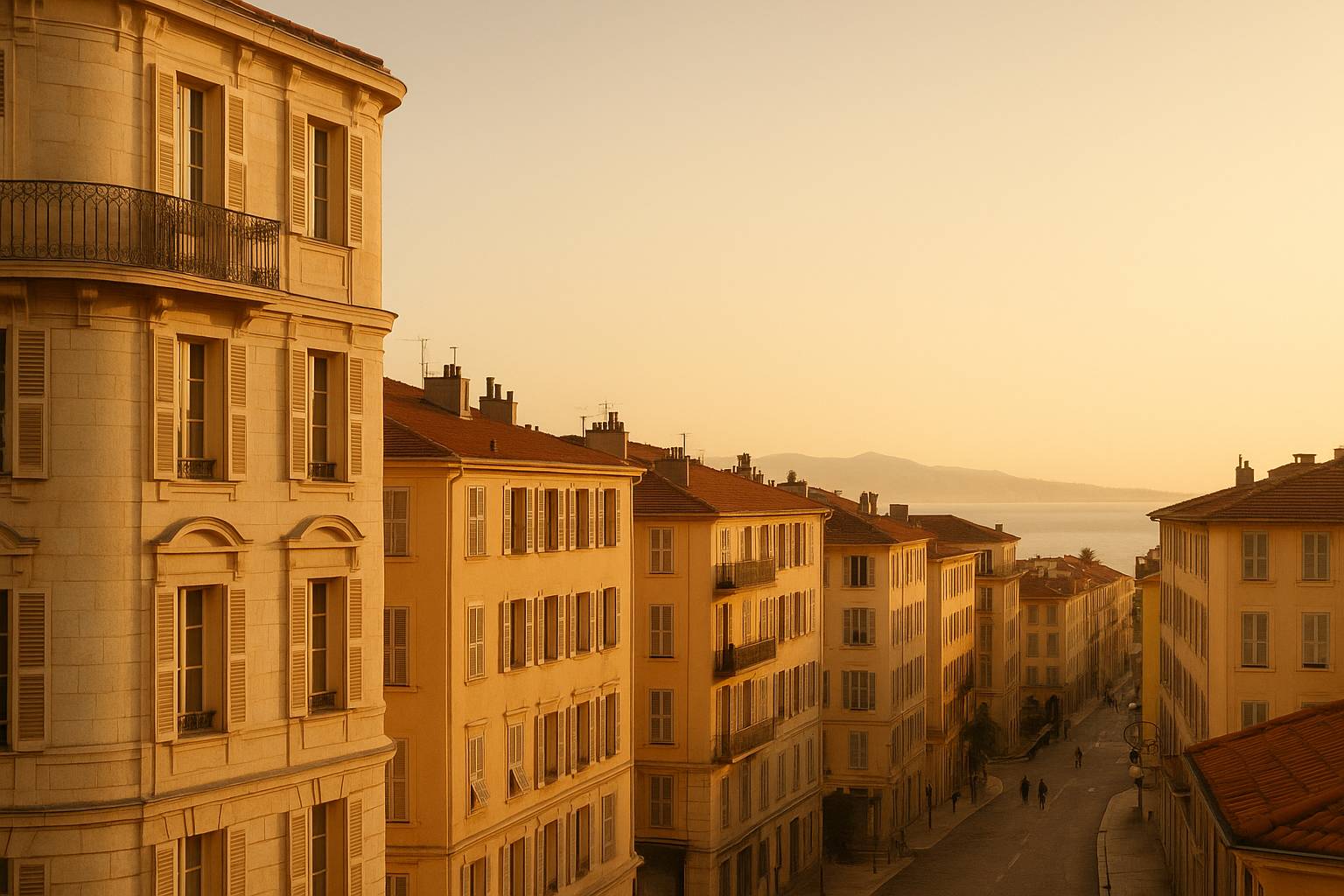
Vieux-Nice is the tangle of ochre alleys between the Cours Saleya and the château hill. It is loud, warm, theatrical, and genuinely beautiful — the closest thing the Riviera has to a Neapolitan quarter. Mornings begin with the flower and produce market on the Cours Saleya, afternoons drift into socca queues at Chez Pipo or René, and evenings bring a slow crawl of aperitifs from Place Rossetti to Place du Palais.
The trade-off is honest: you are sleeping inside a working entertainment district. Windows are single-glazed in most old buildings, restaurant terraces stay lively until 23h in shoulder season and past midnight in July and August, and rubbish collection happens at inconvenient hours. If you're a light sleeper or travelling with young children, choose a flat on an upper floor, courtyard-facing, ideally on a quieter side street like Rue Droite or Rue de la Loge rather than Rue de la Préfecture.
For first-time visitors who want the concentrated Niçoise experience — the market, the gelato at Fenocchio, the baroque churches, the climb up to the Cascade — Vieux-Nice is unbeatable. For a second trip, most people move one neighbourhood over.
Carré d'Or — the elegant centre, and the smartest all-round base
The Carré d'Or ("Golden Square") is the grid of Haussmann-style boulevards immediately west of the Jardin Albert I: think Rue de France, Rue Masséna, Rue Paradis, Rue de la Buffa. This is where Nice does its serious shopping, its Belle Époque architecture and its grown-up cafés. Buildings are taller, streets are wider, and the sea is a three-minute walk down any north–south axis.
What makes the Carré d'Or the sensible default is balance. You are five minutes from Vieux-Nice on foot but sleeping in a properly built 1890s apartment with thick walls, high ceilings and, usually, double glazing. The Promenade is at the end of the street; the tram at Place Masséna connects you to the train station in seven minutes and to the port in twelve. Bakeries, wine shops, a Monoprix and half a dozen good bistros are within one block in any direction.
If you're booking Nice for the first time and you don't have a strong reason to be elsewhere, book the Carré d'Or. It is what "central Nice" actually means.
The southern edge of the quarter, closer to Rue de France and Rue Halévy, tends to be a little livelier at night. The northern edge, up towards Rue de la Buffa and Rue de France's residential stretch, is calmer and slightly more local.
Promenade des Anglais & the Musiciens quarter — sea views, longer stays
The Promenade des Anglais itself is a wide, four-lane boulevard, and the buildings facing it — the Negresco, the Palais de la Méditerranée, the Ruhl — are icons rather than neighbourhoods. Sleeping directly on the Prom is a specific decision: you get the sea view, but you also get traffic noise and a certain distance from everyday life. It suits honeymooners, view-hunters and travellers who plan to spend more time by the water than in the streets.
Just behind the Promenade, roughly between Rue de France and Boulevard Victor Hugo, sits the Quartier des Musiciens, where every street is named after a composer — Rossini, Verdi, Berlioz, Mozart. This is one of the quiet successes of Nice: a residential grid of handsome late-19th-century buildings, five minutes from the sea, ten from Vieux-Nice, and with none of the old town's late-night noise. Rents here are what they are for a reason.
Choose the Musiciens if you're staying a week or more, travelling with family, or simply prefer to close the shutters at night and hear nothing. Choose the Prom itself only if the sea view is the point of the trip.
Le Port — Nice's quiet insider address
Le Port, tucked behind the Colline du Château, was a working harbour until relatively recently, and it still has that useful mixture: fishing boats and superyachts on the water, antique dealers along Rue Ségurane, and some of the best neo-bistrots in the city on Rue Bonaparte and Rue Cassini. The tram line 2 now connects the port directly to the airport in under twenty minutes, which quietly changed the maths on staying here.
The port is calmer than Vieux-Nice, more local than the Carré d'Or, and it feels like a proper Mediterranean quarter — pastel façades reflected in still water, elderly regulars nursing a pastis at 11h, the ferry to Corsica sounding its horn at midday. It is a fifteen-minute walk over the hill (or one tram stop) to the old town, and about the same to the pebble beaches of the Coco Beach cove on the east side.
The catch is that the port is not the beach. If a morning swim is central to your trip, you'll be walking around or over the château hill each day. If you don't mind that, and you want a stay that feels like living in Nice rather than visiting it, this is where I'd send a returning guest.
Cimiez — leafy, residential, Matisse country
Cimiez climbs the hill north of the centre and is, historically, where Queen Victoria wintered. It's green, quiet, and full of enormous Belle Époque villas divided into generous flats. The Musée Matisse, the Musée Chagall, the Roman arena and the olive groves of the Parc des Arènes are all here, and in May the Jardin du Monastère is one of the loveliest places in the city.
Cimiez is not central and it doesn't pretend to be. You are looking at a twenty-minute walk down to Place Masséna, or a short bus ride on the 5. In exchange, you get proper trees, birdsong, and the sense that you've settled into a residential Riviera rather than a tourist one. Families with a car, older travellers, and anyone who values morning quiet above all else tend to love it.
Skip Cimiez if you want to walk home from dinner in five minutes, or if the idea of a hill between you and an evening spritz sounds like a chore by day three.
Libération & Riquier — where locals actually live
Two under-the-radar options are worth naming. Libération, around the Marché de la Libération and the Gare du Sud, is the everyday food market of the Niçois — bigger, cheaper and less scenic than Cours Saleya, and surrounded by excellent, unpretentious restaurants (Peixes, Bar des Oiseaux's newer siblings, a good handful of natural wine bars). It's fifteen minutes on foot from Masséna, or three stops on tram line 1.
Riquier, east of the port, is even more residential — a grid of quiet streets, a small train station with direct services to Monaco and Menton in twenty minutes, and easy access to the eastern beaches. Neither neighbourhood is designed for tourists, which is exactly their appeal on a longer stay.
Which Nice neighbourhood by travel style
If you're still hesitating, a quick sort by trip type:
- First visit, 3–4 nights: Carré d'Or, or the quieter edge of Vieux-Nice.
- Couple, romantic weekend: Vieux-Nice for atmosphere, or a sea-view flat on the Promenade.
- Family with children: Musiciens or Carré d'Or — quiet nights, five minutes to the beach.
- Longer stay (7+ nights) or returning visitor: Le Port, Libération, or Riquier.
- Slow travel, art and green space: Cimiez.
- Day trips to Monaco, Menton, Villefranche: anywhere east of Masséna — Port or Riquier are ideal.
Practical notes before you book
A few things that matter more in Nice than in most cities. First, noise: the old town is genuinely lively until late, and traffic on the Promenade and Boulevard Gambetta is constant. Always check whether an apartment is côté cour (courtyard-facing) or côté rue, and whether windows are double-glazed. Second, lifts: many beautiful Belle Époque buildings have three or four floors and no elevator. If you're arriving with heavy luggage, ask.
Third, parking: driving in central Nice is not worth it. If you're renting a car for day trips, book a stay with a garage or plan to use one of the underground public parks (Palais de Justice, Sulzer, Corvésy). Fourth, getting in from the airport: tram line 2 runs directly from Terminal 2 to Port Lympia via Magnan and Jean Médecin. It's under twenty minutes and costs €1.50 — one of the best airport connections in France.
Finally, seasons. Nice is a genuine year-round city: February carnival, spring on the Promenade, September swimming, mild bright winters. July and August are hot, busy and expensive; May, June, late September and October are, honestly, when the city is at its best.
Tours & experiences to book in Nice
Once you've picked a neighbourhood, these are the bookable experiences that tend to make a Nice trip: a proper socca-and-market walk through Vieux-Nice, a half-day along the corniches to Èze and Monaco, a boat afternoon in the bay of Villefranche, and a Provençal cooking class in an old-town kitchen.
NO DIET CLUB - Unique Local Food in Nice !
★ Walking Tour of Old Nice and Castle Hill
Nice City Segway Sightseeing Tour
The Best of the French Riviera Small group Guided Tour from Nice
Nice: Panoramic Guided Tour in an Open-Top Electric Car
Provence Wine Tour - Small Group Tour from Nice
Experiences offered via Viator — booking may earn Lavie Maison a commission, at no extra cost to you.
Stay in the neighbourhood: our Nice apartments
Book direct with us — the same homes, up to 5% less than on Airbnb or Booking.
Lavie Maison | Sauna & Hot Tub
Grosso
Lavie Maison - Hot Tub AC and Sauna
Carré d'Or
Lavie Maison | Hot Tub Seaside Flat
Grosso
Compare with real hotel prices in Nice →
Where to actually sleep: the case for an apartment in Nice
Once you've settled on a neighbourhood, the second decision is the one most guides quietly skip: hotel or apartment. In Nice, the answer leans harder toward apartment than in almost any other French city. The hotel stock along the Promenade is either very expensive or aggressively average; the beautiful stuff — the 1890s buildings with mouldings, high ceilings, wrought-iron balconies over jasmine-scented courtyards — is almost entirely residential. To sleep in it, you rent a flat.
A furnished apartment also solves the everyday texture of a Riviera stay. You come back from the Cours Saleya market with tomatoes, anchovies and a bottle of Bellet rosé, and you have somewhere to actually use them. You do laundry mid-week. You put the children to bed at 20h and open a bottle on the balcony instead of eating dinner in a hotel restaurant because the room is too small to linger in. On stays of four nights or more, the difference is not subtle.
At Lavie Maison in Nice, our apartments sit exactly in the neighbourhoods this guide recommends most — the Carré d'Or, the Musiciens, and a small selection near the port — in restored Belle Époque buildings with the things that matter (proper beds, real kitchens, working air conditioning, quiet bedrooms). And because you book direct, you pay up to 5% less than the same flats listed on Airbnb or Booking, with no service fees layered on top and a real person answering when you write.
That's the whole pitch: choose the right neighbourhood first, then choose a flat over a hotel room, then book it directly from the people who look after it. Nice is a better city that way.
Frequently asked questions
What is the best area to stay in Nice for first-time visitors?
The Carré d'Or, the grid of Belle Époque streets just west of the Jardin Albert I. It's five minutes on foot from Vieux-Nice, three from the Promenade, and centred on the tram at Place Masséna. You get the atmosphere of the old town without sleeping above a restaurant terrace.
Is it better to stay in Vieux-Nice or the Carré d'Or?
Vieux-Nice is more atmospheric — markets, baroque churches, socca stands, late-night terraces — but it's noisy and the buildings are old. The Carré d'Or is five minutes away, quieter, with better-insulated flats and lifts. First trip: Carré d'Or. Short romantic stay where atmosphere is the point: Vieux-Nice, upper floor, courtyard side.
Where should I stay in Nice to be near the beach?
Anywhere in the Carré d'Or, the Musiciens quarter or directly on the Promenade des Anglais puts you within a five-minute walk of a beach. For the quieter pebble coves east of the port (Coco Beach, Réserve), stay in Le Port or Riquier.
Is Le Port a good area to stay in Nice?
Yes, especially for a second visit or a longer stay. It's residential, full of good bistros, well connected by tram line 2 to the airport, and calmer than the centre. The trade-off is that the sandy beaches and the old town are a fifteen-minute walk over or around the château hill.
Which areas of Nice should I avoid?
There are no genuinely unsafe tourist areas in central Nice, but the streets immediately around Nice-Ville train station (north of Avenue Thiers) feel less pleasant at night and further from what you came for. Sleeping right on Boulevard Gambetta or Avenue Jean Médecin also means constant traffic noise.
How many nights do you need in Nice?
Three nights covers the city itself comfortably — Vieux-Nice, the Promenade, one museum, one long lunch. Five to seven nights lets you add day trips: Èze and Monaco along the corniches, Villefranche and Cap Ferrat by boat, Antibes and Cannes by train, Menton to the east. Nice makes a very good base for the whole eastern Riviera.